Leaders from Washington to Kyiv and Jerusalem paid tribute this week to Senator Lindsey Graham, one of the Republican Party’s most influential and hawkish foreign policy voices. His death leaves a vacuum not only in U.S. foreign policy but also in the Senate, where he often acted as a trusted emissary between President Donald Trump and a chamber not always willing to do the president’s bidding. The scramble is now underway to determine who, if anyone, can fill those roles.
Ask us anything about the midterm elections. Our colleagues will answer questions in the Politics U.S. newsletter every edition between Labor Day, September 7, and Election Day on November 3. Click here to submit your questions.
|
|
|
Latest U.S. politics headlines |
|
|
|
Even in death, Graham is a source of debate.
The Republican senator was “extremely hawkish - he never saw a war that he didn't like,” according to Trump, speaking from the pulpit at Washington National Cathedral during a memorial service on Tuesday.
Not so, according to Fox News Channel host Sean Hannity, who spoke next. “He was often unfairly characterized as a warmonger… The truth was the opposite.”
The competing eulogies for a legendary South Carolina lawmaker came as the Republican Party deals with its own split view - over the Iran war, U.S. support for Israel and Ukraine and how closely to tie themselves to the policy choices of a president nearing lame-duck territory.
Graham was at the center of those debates before he died suddenly from a heart ailment on July 11. A defender of U.S. support for Israel and Ukraine, Graham opposed his party’s populist trend against American intervention abroad. He campaigned to bomb Tehran. And the staunch institutionalist pushed for the Senate’s influence over policy even as Trump has asserted broad executive authority.
In each case, Graham could have run against Trump’s instincts. Instead, he wielded considerable influence with the president, blending the hard-sell, Deep-South charm and inside-baseball politics honed over three decades in Washington. As I’ve traveled with Trump, Graham would occasionally be hovering within earshot of the president, energetic, grinning broadly and prevailing upon the president to take a tougher line in foreign affairs.
|
|
|
|
“He was just a charming man - very charming - funny as hell, and that was kind of the key to his, I think, control over Trump,” said Trump ally-turned-critic Tucker Carlson in an interview with the American Conservative magazine earlier this month.
No one left in the Senate would claim control of Trump.
And with three months until midterm elections determine who will control Congress for the final two years of Trump’s presidency, the White House and the Senate are at odds. Trump has insisted that Republicans do whatever it takes to secure a difficult-to-pass package of voting restrictions called the SAVE America Act. He’s heaped pressure on Senate Majority Leader John Thune, who has said the votes aren’t there to do it. “He should be able to get it done,” Trump said on Wednesday.
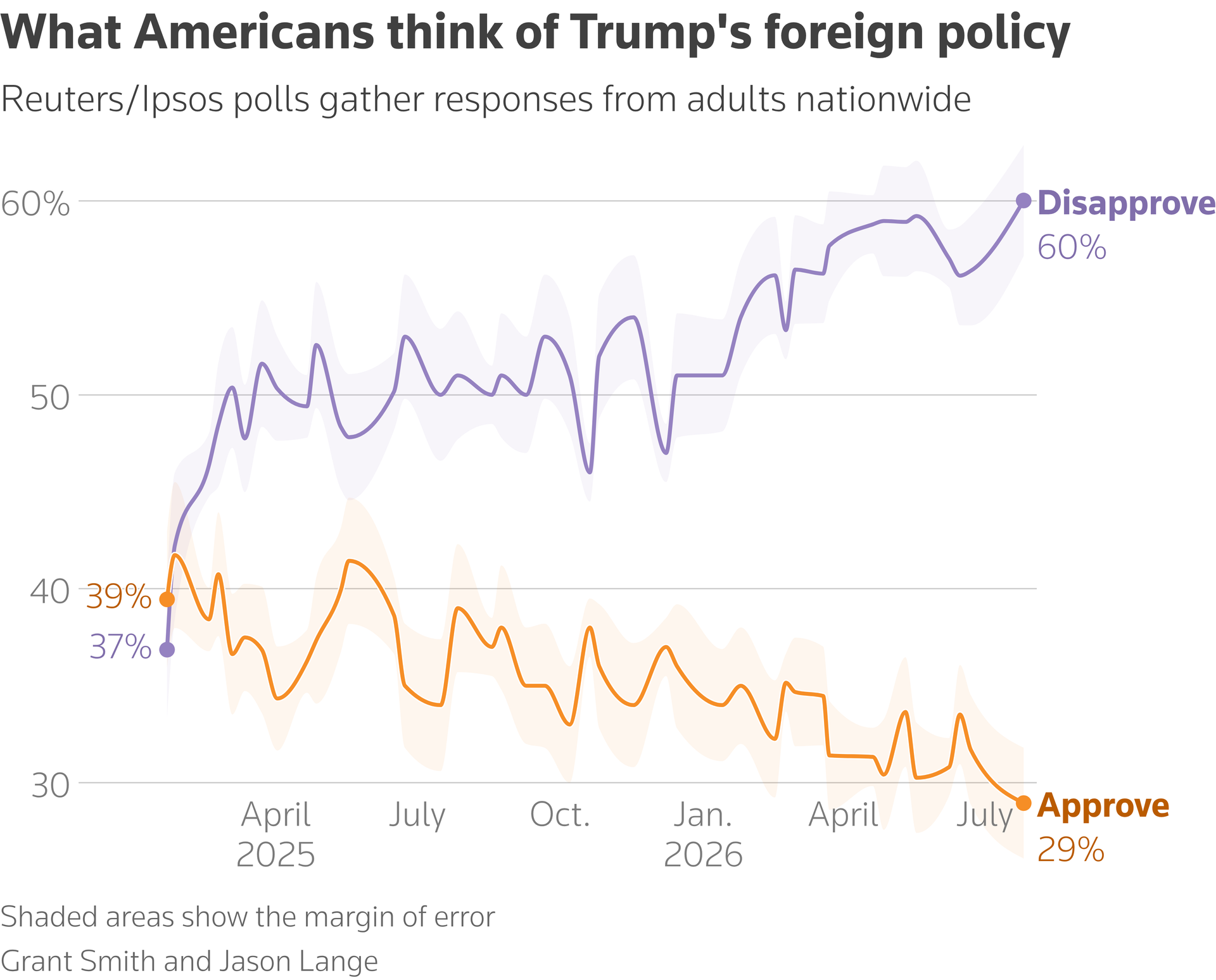
Meanwhile, voters are turning against the war in Iran. When my teammate Bo Erickson traveled to Georgia last week, voter after Trump-supporting voter told him that they had doubts about the president's prosecution of the war with Iran and, for some, his stalwart support of Israel. Just one in three Americans support the war with Iran, a Reuters/Ipsos poll found last weekend.
Before his death, Graham gave voice in Washington to the concerns of Israeli Prime Minister Benjamin Netanyahu and Ukrainian President Volodymyr Zelenskiy. He provided a robust defense of the Iran war even as the public wavered. And he offered a bridge between Trump and Republican traditionalists in the Senate.
For Republicans hoping to hold their party together through midterms, those diplomatic skills may be missed.
|
Follow Reuters/Ipsos polling on the president's approval ratings here.
|
|
|
|
Graham’s death could also be a blow to Ukraine, which is courting Trump for more wartime support. Nonetheless, Congress is fast-tracking a bill Graham endorsed to place stiff tariffs on China, India and other countries to reduce their dependence on Russian oil and gas. Trump has told me he is unsure if his administration would enforce the sanctions. Kyiv, meanwhile, is running critically low on weapons it needs to fend off Russian missile attacks. The Trump administration has told Congress it will not finish spending $400 million Congress has authorized for aid to Ukraine until fiscal year 2029.
|
|
|
|
|
The casket of late Senator Lindsey Graham in the U.S. Capitol Rotunda on the day of a Congressional tribute, Tuesday, July 28, 2026, in Washington, D.C., U.S. Kenny Holston/Pool via REUTERS
|
|
|
|
- July 31: Trump Cabinet meeting at Camp David
- August 4: Primary elections in Kansas, Michigan, Missouri, Virginia and Washington
- August 6: Primary elections in Tennessee
- August 7: July jobs report released
|
|
|
|
This newsletter was edited by Ross Colvin and Alistair Bell and produced by Rawan Yaghi.
|
|
|
|
|
|
| |
|
|
Reuters Politics U.S. is sent once a week. Think your friend or colleague should know about us? Forward this newsletter to them. They can also sign up here. Want to stop receiving this email? Unsubscribe here. To manage which newsletters you're signed up for, click here. This email includes limited tracking for Reuters to understand whether you’ve engaged with its contents. For more information on how we process your personal information and your rights, please see our Privacy Statement. Terms & Conditions |
|
| |
© 2026 Thomson Reuters. All rights reserved.
3 Times Square, New York, NY 10036 |
|
|
|
|
|










Comments
Post a Comment