These include commissioning surveys and polls and assembling briefings on subjects as varied as Argentina’s military-industrial complex, oil resources in the Antarctic, profiles of political leaders, political parties and worker unions and “expert interviews” with “politicians, opposition political scientists and economists”.
The Company even made plans to support opposition candidates in Argentina’s 2025 mid-term legislative elections.
Its most intensive campaign, though, involved creating “a network for the distribution of media content in Argentine mass media and the local segment of social networks”.
openDemocracy has identified at least 250 pieces of content – news, analyses and opinion pieces – that the Russians claimed to have placed in more than 20 online Argentinian news outlets from June to October 2024.
While the Company budgeted more than $280,300 for this content, we have been unable to verify whether the payments were made, and if so, whether they were made to the media, journalists or third parties. The comparatively large figures for Argentina’s cash-strapped media suggest that the Russian agents may have inflated the amount of money required to their superiors in St Petersburg.
The documents also provide clear links between the ‘The Company’, the Russian Foreign Intelligence SVR, and the Wagner group of the late oligarch and mercenary Yevgeny Prigozhin, as laid out in a previous openDemocracy investigation, which revealed how the Kremlin-backed ‘Company’s’ agents tried to prop up former President Luis Arce’s faltering government in Bolivia.
The Company’s existence in Argentina was first publicly confirmed in a speech by Milei’s spokesperson in October 2025. Its operations, the spokesperson said, included disseminating content in social media, influencing local civil organisations, foundations, and NGOs, conducting focus groups with Argentine citizens, and gathering political information to be used in favour of Russian interests.
“This is the declassified portion of the information,” the spokesperson said, “Of course, there's a whole lot of classified information, which is a state secret.”
Now, for the first time, openDemocracy and its investigative partners are able to shed more light on the Russian operations.
Fake fees
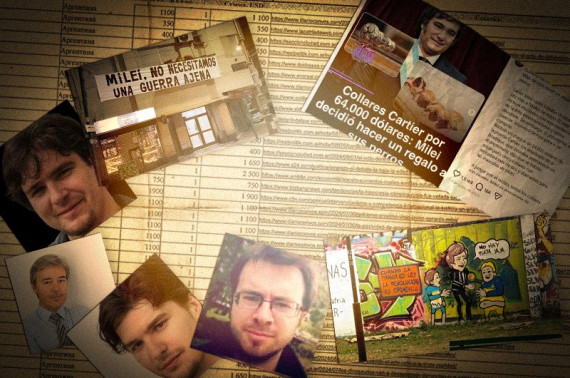
In October 2024, an author called Manuel Godsin published a story about universities protesting Milei’s budget cuts for the Realpolitik news site. It was a topic relevant to his interests; the biography at the end of the piece says Godsin has a PhD from the University of Bergen and is a member of a Centre for Political and Strategic Studies.
What the editors at Realpolitik failed to notice, though, is that Godsin doesn’t exist.
His face belongs to a Russian man named Mikhail Malyarov, as was revealed by Africa Confidential last year and corroborated by an investigation by Code for Africa published last month, which found that Godsin is a “fictitious identity”, created to “whitewash Russian narratives in the mainstream media” using content generated by ChatGPT.
openDemocracy found that Godsin’s article is one of 20 published by Realpolitik that appears in the Russian files. Our analysis of the documents reveals the Russians reported paying $11,000, or $550 a piece, to host the articles on Realpolitik. The site’s director, Santiago Sautel, told openDemocracy he had not received any payments for carrying these articles, and that he didn’t know any of the authors of the 20 pieces.
“We publish opinion pieces all the time,” Sautel said. “We do not know the origin of these particular ones. We can confirm, however, that they were not the result of any underhanded manoeuvre hatched behind closed doors at a diplomatic mission. And if any of these pieces were orchestrated in the shadows to serve a specific agenda, we are unaware of it.”



Comments
Post a Comment