"Luckily, I didn't see [my assaulter] again, but my mother kept running into hers because they lived across the road," Moni says, pointing to the entrance to the community as she herds her seven goats. On the horizon, beyond a hill covered with bushes, Route 81 can be seen. "You just need to cross it," she adds. "It's a 10-minute walk."
Forty years ago, Route 81 was a dirt road that was impassable during rainy seasons. Its paving represented progress for the people of Salta and the neighbouring province of Formosa. But not for the Wichí.
Since the road was paved, it has become easier for the residents of Pluma de Pato to abuse the Wichí girls and women. But it has also opened the Wichí people up to attacks from other criollos passing through the area. Route 81's thousands of kilometres have become a no-man's land, where seasonal workers take advantage of its proximity to border crossings during the planting and harvesting seasons, and truck drivers pull over looking for Indigenous girls and teenagers.
Moni leads her goats to her family's shack. It is seven o'clock, and the evening sun bathes the land populated by pigs, roosters, chickens, dogs and more goats in golden light. Her sisters come out to meet her, and they laugh as they watch their mother feed five parrots in a bucket.
For over an hour, the family sits in a circle in the courtyard as Moni recounts what happened three years ago in Pluma de Pato. The women who signed the letter don't want to talk any more, she says. "They regret having brought it to light. They're afraid."
Losing their fear
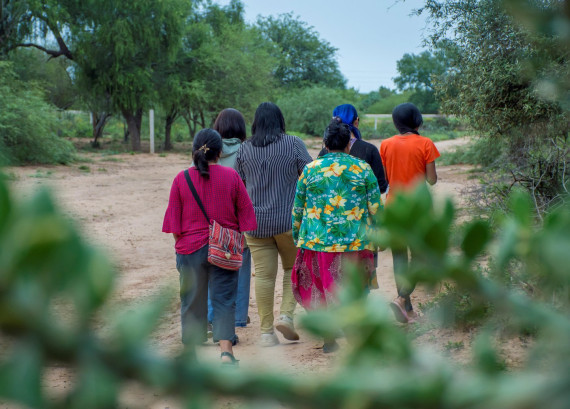
On 16 January 2022, a month before they signed the letter, Moni and other Wichí women crossed Route 81 and marched through the streets of Pluma de Pato. They walked in rows, linked together and carrying a large banner that read, 'Justice for Pamela'.
Twelve-year-old Pamela Flores' body had just been found lying in the grass beside the road. She had been missing for several days, during which time Moni had not slept. "She used to come to our house, we looked after her," she says. "Now, when I see a girl on the road, I immediately think of her".
Flores' boyfriend, a 17-year-old from the Wichí community, was detained and indicted for the crime in 2023. But some news reports suggest her family thinks justice was not fully served, believing a criollo man was also involved and escaped punishment.
The Wichí women were fed up with seeing their daughters go missing. Before marching, they gathered and called on Octorina Zamora, a leader of Indigenous women in the area. Seven years earlier, Zamora had supported the family of Juana*, another 12-year-old Wichí girl who was killed and her body dumped on a football pitch in far north-east Salta.
Juana had gone out to buy bread with two friends when eight criollo men chased them. Her friends managed to escape, but Juana was dragged to the football field, drugged and raped. The case shocked the province. Juana had a disability and was pregnant from a previous sexual assault. It was the first case of gang rape of a Wichí girl to go to trial, with her attackers found guilty.
After Flores' death, Zamora again took the lead. Zamora's daughter, Tujuay Gea Zamora, who has been supporting women in the area since her mother passed away in June 2022, says: "They [the women] were determined. They wanted to take action, but they needed the strength that [my mother] somehow gave them."
Zamora arranged for the First Assembly of Indigenous Women of Route 81 to take place on 11 February 2022, organising under the slogan 'Nehuayiè-Na'tuyie thaká natsas-thutsay-manses' (Wichí for 'let's accompany our children and adolescents').
She called on national and provincial authorities to attend. On the day, a helicopter arrived, carrying the ministers of social development, justice, and indigenous affairs, as well as a member of the Secretariat for Human Rights, the national ombudsman for Children and Adolescents, the local police chief, and a representative of the National Institute against Discrimination, Xenophobia and Racism.
Journalists from national media outlets, who rarely visit Salta's Chaco region, also arrived, crowding around with their cameras to cover the meeting. The Wichí women say it was the first time the media had treated them with respect, acknowledging that they'd managed to organise, march, call the meeting and bring the attention of authorities.
Until then, news reports had always portrayed the women as not being in control of their own lives, showing them with their heads bowed, walking barefoot along the dirt roads. "They had made us look like animals, like inferior beings, like people who need constant assistance and are not worthy of respect. That the best thing that can happen to us is to be part of servitude, which includes sexual servitude," Tujuay Gea Zamora says.
The white demon
During the assembly, the women denounced neglect from the state, ranging from poor education to a lack of proper health care and barriers to the justice system. They raised a need to establish an emergency committee to address situations of violence against Indigenous children, adolescents and women.
It was not just a meeting with the authorities. The assembly provided a safe space for women to break their silence, which was as deeply rooted as the abuse itself.
Three days later, Moni and 20 other women signed the public letter addressed to the provincial minister of security and justice, Abel Cornejo, exposing for the first time the sexual violence that had marked the lives of the Wichí people for centuries. It said:
"The women who sign this letter are mothers of children born of relationships with criollo men, as they are commonly called in this area, men who do not belong to our community.
"Most are children of people who walk the streets of the town with impunity. They are the children of the first road workers who came from other provinces, the children of shopkeepers, butchers, police officers, gendarmes, teachers, nurses, and all those who at one time wanted to 'satisfy' their sexual desires with our bodies."
There are 70,000 members of the Wichí across Argentina, according to the 2022 census. Many years ago, when they lived in the forest, the Bermejo and Pilcomayo rivers were their protective shield. Sheltered by the rivers' banks, women gathered wild plants and fruits and wove with the fibre of the chaguar leaf, while men hunted and fished.
But since the conquest of the Great Chaco (a region comprising parts of Argentina, Paraguay, Bolivia and Brazil) and the 19th-century invasions that founded the Argentine nation state, the criollos have advanced on their territories and on the bodies of the women.
Read the full investigation here.










No comments: