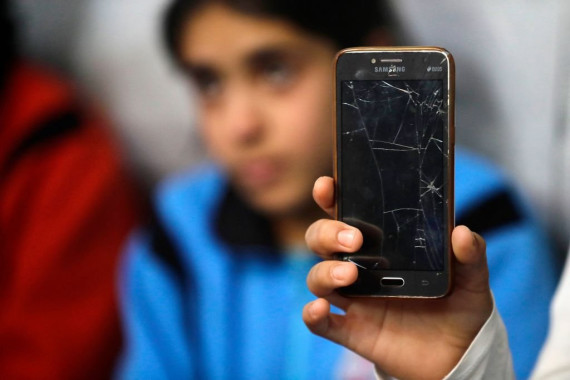
Repairing together is more than fixing things; it's how we rebuild trust, share knowledge, and remind each other that sustainability starts with care. Each repaired item represents restored communication, renewed access to information, financial services, safety, entertainment/edutainment, continued education, job opportunities, and extended livelihoods for families who depend on these tools daily. It also reduces e-waste, a growing cause of environmental harm.
Take Mawa, a university student living in Rhino camp, who was reliant on his laptop for studying and staying connected. When it stopped working, Mawa "lost hope". With our support, the laptop is fixed, and Mawa has the tools and knowledge to repair it themselves if it breaks again. "Seeing it repaired gave me strength again," he said. "I can now resume my online studies and stay connected."
So far, we have trained over 300 refugee youth on basic electronics repair, safe use of the internet, data safety and security, job search, and online learning, hosted 23 repair cafés, repaired more than 2,500 devices and created 10 open educational resources that enable access to online and offline learning resources.
One project participant, Rose, said: "Before the electronics repair training, I couldn't fix even simple devices and often relied on others, spending money I didn't have. The hands-on sessions taught me to identify faults, use tools, and repair items like lights, radios, solar panels, and phones. Now, I not only fix my own devices but also help neighbours, saving money and reducing e-waste. This training gave me skills, confidence, and hope for a sustainable future. I'm grateful to CC4D for empowering me and transforming my life."
The Community Creativity for Development has also conducted two online campaigns, including the one responding to Microsoft's end of support for Windows 10. Many refugees rely on older computers that cannot run Windows 11, leaving them exposed to security risks and data loss. This global tech transition has become a silent digital crisis for displaced communities with limited internet access and low digital literacy.
Some of the challenges we have faced include limited funding and a lack of repair forums in Africa. We were able to get a small amount of funding to conduct our activities through connections with organisations in the global repair community, including The Restart Project, a London-based charity that helps people learn how to repair electronics and r0g Agency, a Berlin-based nonprofit. We also raised funds through crowdfunding campaigns with the help of Sweden's Repair Café Malmö, which helped to set up our GoFundMe, as the website doesn't operate in Uganda.
Today, our work extends beyond repair services to policy advocacy, calling for the inclusion of repair in humanitarian aid and building the Africa Repairers Network (ARNet) to promote, protect and revitalise Africa's repair culture.
We believe repair is a digital right, an act of care, a tool for empowerment, and a pathway to sustainability. Repairing together rebuilds trust, restores dignity, and reminds us that sustainable futures begin with care. Repair is healing. Repair is connection. Repair is justice. Repair has no boundary, whether fixing things, systems, or societies.










No comments: