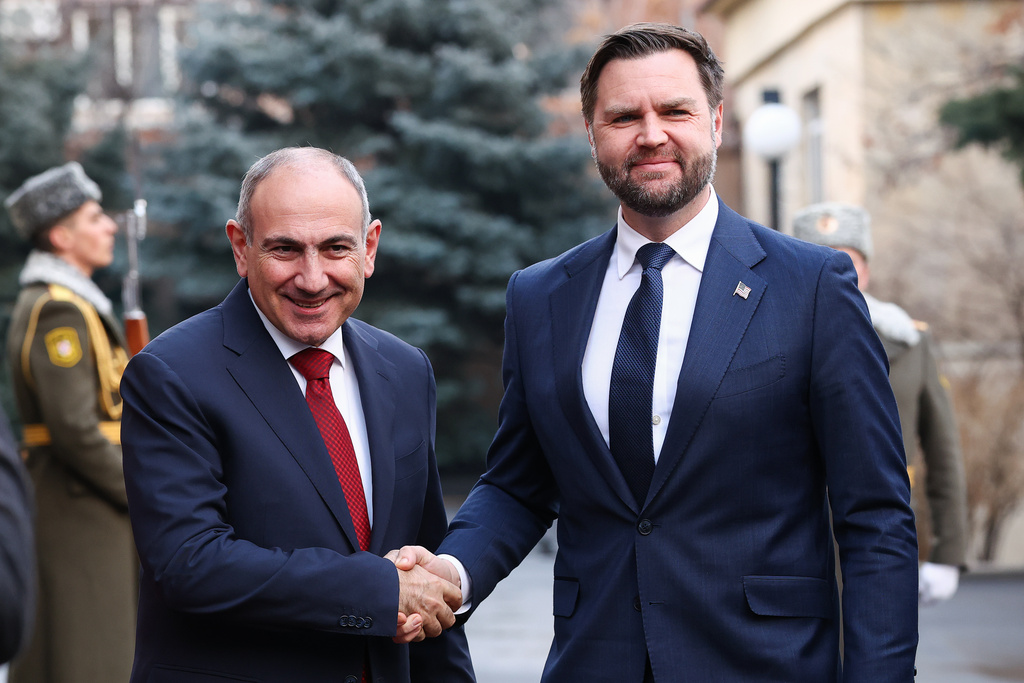
Good evening from Armenia. I'm writing to you from Yerevan, where Vice President JD Vance is wrapping up a high-stakes visit before heading tomorrow to neighboring Azerbaijan.
On paper, this trip is about shoring up a U.S.-brokered peace effort between two countries with decades of hostility and multiple armed flare-ups in just the last five years. In reality, it's about something bigger: influence, trust and where a small country caught between great powers goes next.
Last year, the White House helped bring the leaders of Armenia and Azerbaijan to Washington to sign a framework agreement aimed at reducing tensions. Central to that deal is a proposed transit corridor connecting mainland Azerbaijan to its western exclave through Armenian territory — a choke point that has fueled resentment, blockades and periodic violence for years. The plan is still short on details, but it represents a rare moment of sustained American engagement in a region long viewed as Russia's backyard.
And people here feel that shift.
We spent time on the streets asking Armenians how they see the future — and whether peace with Azerbaijan is actually sustainable.
When I asked one woman if she had confidence the situation would stabilize, her answer was blunt:
"Absolutely not. Unfortunately, I don't think so. [Azerbaijan] will break the peace contracts."
Others were more cautious but no less realistic.
"There's still a risk of conflict," one man told me. "There are still other risks. But hope is there, I would say."
That mix of skepticism and fragile hope came up again and again.
We also asked a question that gets at the heart of the geopolitical tug-of-war playing out here: Should Armenia continue to orbit Russia or move closer to the United States and the West?
"If the United States' interests are coinciding with Armenia's interests, why not?" one man replied.
When I followed up with another woman and asked whether Armenia could still trust Russia, her answer came instantly:
"No."
A different woman put it this way: "There are some Armenians who are looking for some alternatives."
That may sound understated, but in this region, it's seismic.
Armenia has relied on Russia economically, militarily and politically for decades. There's even a major Russian military presence just miles from where we're reporting. For Moscow, any deepening Western role here is viewed as encroachment. For Armenians, Russia's perceived failure to fully protect them in recent clashes with Azerbaijan has left deep scars.
That's why this visit matters.
Vice President Vance's presence sends a signal — not just to Baku, but to Moscow, Tehran and Ankara — that Washington intends to stay engaged in the South Caucasus. Whether that engagement leads to lasting stability or simply shifts the balance of risk is still an open question.
The optimism is cautious. The doubts are real. But one thing is unmistakable: People here understand that something is changing.
Tomorrow, the vice president heads to Azerbaijan. The conversations there may sound very different — and that contrast itself will be telling. |









 Megyn Kelly -> Pete Hegseth responds to 2017 rape accusation. 🔥 vol. 3, issue 13 | December 6, 2024 Quick Hits All the news you need in...





No comments: