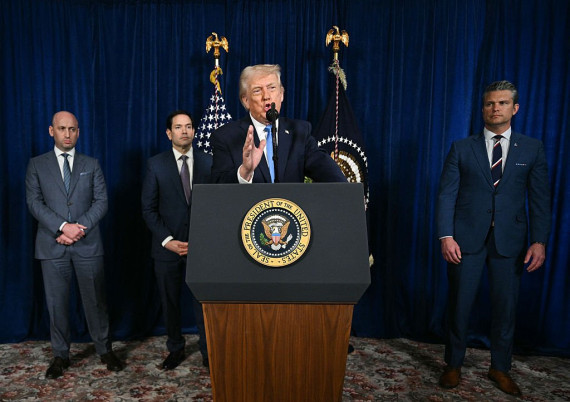
When asked about elections, democracy or the release of some 800 political prisoners, Trump and his secretary of state, Marco Rubio, reply that all this "is premature". The nature of the events indicates the coup was orchestrated with a part of the regime whose head was Maduro.
Nothing remains of Venezuela's Bolivarian revolution of the 1990s, not even dignity. Delcy Rodríguez, Maduro's vice-president and one of the most vocal figures in his administration, has been appointed interim president, with Trump's acquiescence. She and her brother Jorge, the president of the National Assembly, Diosdado Cabello, the minister of the interior, and Vladimir Padrino López, the head of the armed forces, have become administrators of a Trump protectorate – a new, perhaps provisional, status quo that sets Venezuela and all of Latin America sailing into uncharted waters.
The eternal misunderstanding
In a speech to the US Congress 202 years ago, US president James Monroe laid the foundations for his new country's relationship with the other republics emerging across the American continent amid struggles against the European colonial powers.
That relationship would be one of US dominance and Latin American subordination, although the Monroe Doctrine was presented as a warning against new European colonial adventures in America.
"America for Americans" – Monroe's phrase that coined the eternal misunderstanding – postulated that America, the continent, was for them, who called themselves "Americans". In that single remark, the rest of the American peoples were left in an inferior category, confined to their nationalities or to a subordinate belonging to the same single continent (Latin Americans, South Americans, Central Americans or Caribbeans). Never simply Americans.
Other US presidents followed Munroe's lead. More than five decades after his doctrine came Rutherford Hayes's corollary of 1880, on the need for the US to have exclusive control in Central America and the Caribbean, and therefore of any interoceanic canal, followed by Theodore Roosevelt's corollary of 1904, which postulated the freedom of the US to intervene by force in any country on the continent if it considered that its interests were affected.
Just a few weeks ago, on the anniversary of the Monroe Doctrine, Trump published his own corollary, which contains nothing new, though the foreign power to keep away now is no longer Europe but China. The novelty lies in what began in Venezuela.
The question of democracy
In December, the UN reported that Venezuela's human rights situation was continuing to deteriorate. In 2021, the International Criminal Court's prosecutor opened a formal investigation into crimes against humanity, such as torture, disappearances and executions at the hands of the state.
Like Delcy Rodríguez now, Maduro became interim president in 2013 after the death of leader Hugo Chávez. Shortly afterwards, he won the elections by a narrow margin and, from 2015 onwards, took an openly authoritarian turn when he refused to recognise the result of parliamentary elections that left him without a majority in the National Assembly.
Opponents of the regime tried different approaches to overthrow it. To name just a few: peaceful demonstrations, violent actions, calls for a military uprising, attempts to get neighbouring governments to blockade the country, support for economic sanctions by the US and the European Union, complaints to international organisations, boycotts of elections they considered rigged, negotiations with the regime mediated by third countries, and massive participation in elections. None of this moved the needle.
Despite the opposition's victory in the 2024 presidential elections, Maduro was once again proclaimed president, through fraud.
Then Trump reappeared, with a military deployment unseen in decades, indiscriminate bombing of ships in the Caribbean and the Pacific, and persecution and stigmatisation of Venezuelan migrants as terrible criminals and mentally ill people ravaging US cities.
The main opposition leader, María Corina Machado, who recently won the Nobel Peace Prize, clung to this strategy like a lifeline in the storm. She argued that the military siege, theaccusations of narco-terrorism against Maduro and his circle, and the imminent military action by Washington would bring down the regime and open the door to a transition. Shortly after Maduro's kidnapping, Machado proclaimed: "Today we are prepared to assert our mandate and take power."
Trump's response could not have been colder. He removed her from the scene, claiming she lacked the necessary "respect" and "support" for the moment.
In an interview with Fox News on Monday, Machado tried again to court Trump and said she wanted to give him her Nobel Peace Prize, which the US president has long coveted and considers himself deserving of. The body that awards the prize, the Norwegian Nobel Institute, was forced to clarify that it cannot be transferred to third parties.
There were celebrations by Venezuelans in exile in cities across the western hemisphere when Maduro's overthrow was announced, but not within Venezuela. Maduro no longer governs there, but the same regime does, under Trump's shadow.










No comments: