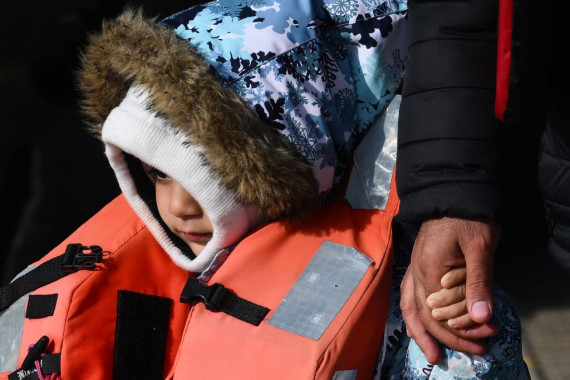
More than 20,800 people received refugee family reunion visas in the year ending June 2025, a 30% increase on the previous year. The majority were women and children, most of whom were arriving from Syria, Iran, and Afghanistan.
Many of those who applied to bring their family over arrived in the UK via irregular means, such as crossing the Channel on a small boat. As the journey is so dangerous, young men often travel alone to claim asylum, before bringing their families over safely on the reunification visa.
The far right has increasingly stigmatised the young men who make this journey as "fighting age men", with the suggestion being that they are a threat or an "invasion". But the reality is many are teenagers struggling with the trauma of "missing their parents and missing their families", said Syedain.
Family separation, said Syedain, makes it harder for individuals to "concentrate on their own recovery because they are still inside the trauma of the separation from their families".
"They're so fearful for the safety of their families at home, and often rightly so," she said. That fear, she added, is often combined with trauma linked to guilt "for having left family members behind, and guilt for not being able to look after them the way they want to".
Syedain continued: "This is a huge part of what these young people experience and carry with them into adulthood. They have these experiences of both being emotionally quite young, because they've been torn away from their families at a very young age and had important attachments interrupted. On the other hand, they're incredibly mature and streetwise, because they've had to look after themselves in all sorts of ways."
In some cases, it is the family member who is most at risk who journeys first to the UK, such as a parent who has faced persecution or torture. They can then struggle to explain to their children why they have been separated, because, Syedain explained, "most parents obviously don't say to their children, 'oh, your father was tortured, that's why he escaped.'"
She added: "And then years later, they are reunited, and dad is nothing like he was before. Parents do their best to try and kind of tell a story about why it is, or say nothing. When that happens, children try to fill in the gaps."











No comments: