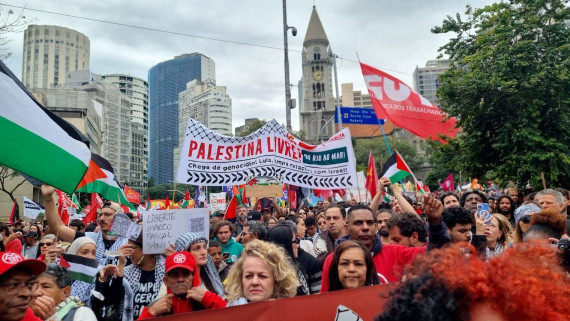
Latin America is broadly supportive of Palestinian rights. All states in the region except Panama recognise the state of Palestine – even Argentina, whose right-wing government led by Javier Milei was one of just 10 countries to vote against a UN resolution on a two-state solution last month – and only Guatemala does not have a Palestinian embassy. Mexican president Claudia Sheinbaum also officially welcomed the country's first Palestinian ambassador, Nadya Rasheed, earlier this year – becoming the latest country in Latin America to do so.
But the region has been less united on how far it is willing to criticise Israel's assault on Gaza over the past two years.
Weeks after the assault began, Bolivia, along with four other countries in Africa and Asia, filed a complaint against Israel with the International Criminal Court (ICC), sparking an investigation into alleged war crimes and crimes against humanity. Two months later, in January 2024, Chile and Mexico also denounced possible "war crimes" committed in Palestine before the ICC. The investigation has since led the ICC to issue arrest warrants against Israeli authorities and Hamas leaders.
Also in January 2024, Brazil became the first Latin American nation to describe Israel's actions as a possible "genocide", with its foreign ministry releasing a statement in support of a South African lawsuit accusing Israel of genocide at the International Court of Justice (ICJ).
Colombia officially applied to join South Africa's genocide case in April 2024, and Mexico did so the following month, while former president Andrés Manuel López Obrador was still in office (Sheinbaum, who took office in October last year, did not use the word "genocide" until a press conference last month). Chile applied to join in September 2024, Bolivia in October 2024, Belize and Cuba in January 2025, and Brazil last month.
None of this was endorsed by Uruguay, which is often upheld as particularly progressive and has been governed by a left-wing coalition of parties called Frente Amplio (FA, which translates as Broad Front in English) since March this year.
Its government has refrained from denouncing Israel's actions as "genocide", despite pressure from social movements and some sectors of the FA, although the coalition's parliamentary groups did not shy away from calling it such in a statement released last month. "The terrorist act perpetrated by Hamas on 7 October 2023 does not justify, under any circumstances, the ongoing genocide," they said.
"There are no differences within the political force," Fernando Gambera, the president of the FA's International Affairs Commission, told openDemocracy, saying that the coalition and the individual parties that comprise it "have concluded that what is happening in Gaza is genocide".
But activist Mónica Riet from Uruguay's Coordination for Palestine, an umbrella network of trade unions, student and social organisations, told openDemocracy that the FA "has not had a clear definition of condemning genocide and breaking ties with the Zionist government".
Yamandú Orsi's administration, Riet noted, has instead merely paused Uruguay's academic exchange contract with Israel, while other countries in Latin America have taken more drastic measures. Bolivia, Colombia and Nicaragua, for example, have severed diplomatic ties with Israel, and Bolivia, Colombia, Cuba and Honduras have joined the The Hague Group, which seeks to apply legal and diplomatic sanctions against Israel for its breaches of international law. Petro's government in Colombia has also banned coal exports to Israel.
Chile versus Argentina
Neighbours Chile and Argentina, which have historically both been supportive of a two-state solution, could not be further apart in their positions today. Chile is governed by a coalition of left-wing and centre-left parties, while Argentina's right-wing administration is allied with Donald Trump and Binyamin Netanyahu.
Chile is home to nearly 400,000 people of Palestinian descent – the largest Palestinian community outside the Arab world – and has been clear in its support for Palestine over the past two years.
In October 2023, weeks after the assault on Gaza began, Chile made a $200,000 contribution to the United Nations Relief and Works Agency for Palestine Refugees, and later went on to receive 68 refugees from Gaza. Under pressure from the Chilean-Palestinian Interparliamentary Group and the Chile-Palestine Friendship Group in the Senate, President Boric also withdrew Chile's military attachés and recalled its ambassador to Israel.
The Chilean Defence Ministry also excluded Israeli companies from the 2024 International Air and Space Fair in Santiago, while the country's Foreign Ministry told openDemocracy that it has introduced bills to ban "the import of products produced in illegally occupied territories". Israel is Chile's primary arms supplier, but the ministry said it is taking measures to "stop depending on Israeli industry".
"We have supported diversifying defence suppliers and thereby cutting contracts with Israeli suppliers [given] their total disregard for international law, which are the common rules to which all armed forces in the world must submit," ruling party MP Jorge Brito, a member of the Chilean-Palestinian Interparliamentary Group and the parliamentary defence committee, told openDemocracy.
Argentina's right-wing President Milei, meanwhile, has unsurprisingly displayed unwavering alignment with Israel and the US. What is more shocking, though, is the lukewarm response from the country's progressive opposition, which is in stark contrast to the position the Argentine government held on apartheid in the 1980s. Back then, president Raúl Alfonsín cut all diplomatic relationships with South Africa and joined the international boycott against South Africa.
While former president Cristina Fernández de Kirchner, the leader of Congress's largest centre-left movement, was quick to condemn the 7 October 2023 Hamas attack on Israel, she remained silent on Israel's actions in Gaza until last month, when she posted a video of a right-wing politician denouncing Israeli crimes on X with a caption that accused Israel of "genocide".
Fernández's coalition movement, the Unión por la Patria (Union for the Motherland), which has a left-wing Peronist majority, did not speak out about Israel's war crimes in Gaza until in February of this year, when it drafted a resolution urging the executive to "reject the statements made by US president Donald Trump about 'cleaning up the Gaza Strip"'.
The Unión por la Patria has since drafted a motion against Israel's plans to occupy the Strip militarily and to "express concern about the serious humanitarian crisis affecting the civilian population" in Gaza. The coalition also called for Netanyahu to be "declared persona non grata" after it was announced that the Israeli prime minister was planning to make an official visit to Argentina (Milei later cancelled the visit, reportedly fearing the political fallout ahead of the parliamentary elections.) But still, for most of the past two years, its members and parties have largely avoided using the word "genocide" to criticise Israel, only doing so in the last few days as pressure mounted on Israel to agree to a ceasefire.
One of Unión por la Patria's members, the Peronist Justicialist Party, also failed to accuse Netanyahu of "crimes against humanity" until last month, when it for the first time criticised Israel's expansion in the West Bank and "indiscriminate killing in Gaza".










No comments: