Direct action protest, such as that carried out by Palestine Action, may involve crossing a line of criminality to disrupt or bring attention to activity that groups believe is causing greater societal harm. Committing a crime does not make a protest group's actions "terrorism" and there are dangers in applying counter-terrorism powers in this context.
The parliamentary vote took place on the anniversary of women being given equal voting rights with men, after a campaign by the suffragettes that was far more violent than anything organised by Palestine Action. This irony was not lost on Clive Lewis MP, who said:
"The suffragettes carried out a campaign of window-smashing, poster and paint defacement, cutting telegraph and railway lines and targeted bombing and arson, but specifically avoided harming people. There is a long history in this country of direct action that pushes the boundaries of our democracy. It is very difficult for all of us, but this is still direct action, not terrorist action."
In the end, Lewis was one of just nine Labour MPs to vote against the proscription, which passed by 385 votes to 26, with the Liberal Democrats and Scottish National Party abstaining. The ban on Palestine Action will come into effect this weekend, after the High Court ruled against a judicial review.
To ban a group, a home secretary only has to demonstrate a belief that it is connected to terrorism, not proof on a balance of probabilities or beyond reasonable doubt. Some Conservative MPs wanted to use these provisions against groups such as Just Stop Oil and Insulate Britain, but the previous government pulled back from doing so (although not without radically extending public order measures). A Labour government, desperate to shore up its security credentials, jumped right in.
The 2024 report by Lord Walney opened the space for blurring the definitions of extremism and protest by warning against the activities of 'extreme political activists' and advising the government to introduce restrictions on the activity of such organisations. The report particularly focuses on 'environmental campaigns, anti-racism, anti-government protest, anti-Israel activism, and anti-fascism'. The proscription of Palestine Action constitutes an expansive use of the Terrorism Act 2000, and through the further criminalisation of non-violent protest and freedom of expression, sets a dangerous precedent for rights and freedoms in the UK.
That the UK government has not explained why the use of a ban is necessary – why is ordinary criminal law not fit for purpose in this instance? – calls into question its commitments to freedom of expression and association under Articles 10 and 11 of the European Convention on Human Rights.
Terrorism scholars and experts have previously warned about the arbitrary and racialised nature of proscription, where the absence of an internationally agreed-upon definition of terrorism allows for the flexible, ambiguous and political usage of the term by states.
In the UK, the Terrorism Act 2000 defines terrorism as including efforts to "influence the government or to intimidate the public or a section of the public" in respect of a political cause. To fit within this definition, a group does not have to terrorise society; it could simply be attempting to change government policy. For the government, Palestine Action's use of 'pyrotechnics and smoke bombs' sufficed for intimidatory activity.
As for how a group's cause is advanced, the act encompasses not just violent attacks, but also "serious damage to property". When this law was being debated, an earlier generation of Labour politicians assured Parliament that requiring "serious" damage would prevent counter-terrorism powers from being needlessly employed. Damaging a grounded plane with spray paint, the current government believes, meets this threshold.
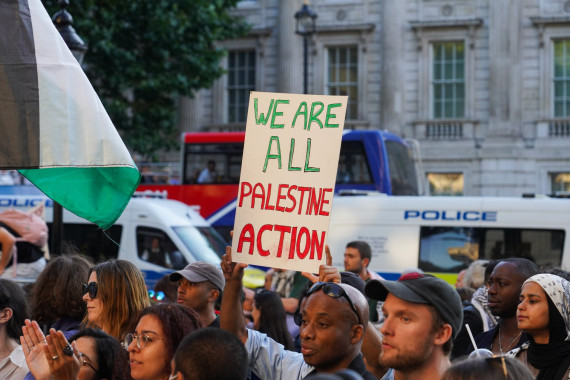
In passing the proscription, the government ignores that Palestine Action's aims and activities are backed by a broad base of people in the UK. They are now at risk of being criminalised, as detailed by an open letter signed by over 1,300 academics, trade unionists and members of the public.
Palestine Action seeks to end corporate complicity in Israeli state violence and has specifically targeted the activity of Elbit Systems, an Israeli arms company that has subsidiary factories in the UK. Some 57% of the British public supports a full arms embargo on Israel, according to polling commissioned by the Palestine Solidarity Campaign, and hundreds of thousands of people have joined protests calling for an end to the UK's arms exports to Israel since the war began.
University campuses across the UK have been particular sites for this form of solidarity, and as such have already been targeted by efforts to restrict freedom of expression in support of Palestine. These are now having a chilling effect on both protests and lecturers' discussions with students; since 7 October 2023, there has been an increase in the number of people reported through the Prevent duty by universities, and at least 28 universities have launched disciplinary action against staff and students.
We have also seen concerted attempts to criminalise both protest speech and protest actions on campus, often instituting severe legal penalties for things that no rational person would consider a crime. Several university managements have obtained High Court injunctions that cast their own students and staff as "trespassers" and "occupiers" for engaging in "unauthorised" protest on university property.
A Cambridge University student who unfurls a Palestinian flag and makes a speech that disrupts their graduation ceremony, for example, could face a jail term or a large fine for contempt of court, thanks to the order obtained by the university on 21 March. As is normal for this type of court order, speech related to protest is also criminalised, with penal clauses for people who "instruct or encourage others" to breach it.
Administrators at Cambridge, which has active research collaborations with companies engaged in the Israeli military supply chain, justified this repressive spasm with claims that student encampments stopped institutional business and prevented staff from getting to work.
Notably, Dan Jarvis made exactly the same point in summing up the government's case for the proscription of Palestine Action in Parliament: "Palestine Action's attacks are not victimless crimes; employees have experienced physical violence, intimidation and harassment, and they have been prevented from entering their place of work."
Just as the government appears to be learning from repression on British campuses, so should we. University solidarity campaigns offer important positive lessons about ways to challenge repressive legal manoeuvres.
Attempts to split off activists involved in direct action from the support of a wider movement have been challenged by staff trade unions. University and College Union (UCU) branches in Leicester, Cambridge, Oxford and Newcastle, to name a few, have made statements and organised practical forms of solidarity with students and defending their right to protest.
Cambridge's UCU branch has passed motions, issued statements and donated towards the legal campaign against the injunctions. Similar actions will all be essential elements in the campaign against the proscription of Palestine Action.
The ban on Palestine Action comes at a point when the constraints upon the state's security powers have been substantially weakened over several decades. It is not surprising that the supposed boundaries between direct action protest and terrorism have been broken down in the minds of politicians. But this makes it all the more important that society, and the courts, do not blithely accept another unnecessary recourse to special counter-terrorism law.











No comments: