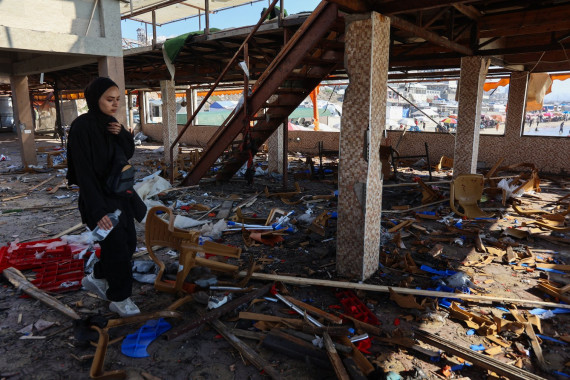
One was the destruction of the al-Baqa seaside café in Gaza on Monday, killing at least 30 people, according to the Gazan Health Ministry, and injuring many more. The cafe was one of the few businesses in Gaza that had remained open despite the war, and it provided a sanctuary to many, serving a small selection of soft drinks, tea and biscuits.
Bomb remnants established that it was wiped out by a US-made Mark-82 230kg general purpose bomb, which produces a very strong blast and masses of high velocity shrapnel fragments. It is especially effective against what are termed 'soft targets' such as people, and used against a crowded café it would be intentionally devastating.
The second incident was the killing of a much-respected cardiologist and director of the Indonesian hospital in Gaza City, Dr Marwan al-Sultan. A Palestinian medical group, Healthcare Workers Watch, reported that he was the 70th health worker to be killed by Israeli attacks in the past 50 days.
Throughout the 21 months of the war, hospitals, health centres, ambulances and health workers have been key IDF targets, with every hospital in Gaza having been attacked at least once. UN sources report more than 1,400 health workers killed since the war started. When there have been airstrikes against dwellings, they commonly occur at night with family members frequently killed.
The IDF is increasingly relying on the Dahiya Doctrine, which is used against uprisings that are too difficult to counter with troops on the ground. The doctrine's aim is to destroy entire neighbourhoods with air strikes, armed drones, tanks and artillery, so that Gazan public support for the insurgency falters.
This has yet to happen, despite the appallingly grim effect that the siege of Gaza is having. According to the UN World Food Programme and partners, most families receive only one 'meal' a day. It reports that:
"The meals which families are able to obtain are nutritiously poor — thin broths, lentils or rice, one piece of bread or sometimes just a combination of herbs and olive oil known as duqqa.
Adults are routinely skipping meals in order to leave more for children, the elderly and the ill. And still, on average since January, 112 children have been admitted on a daily basis for acute malnutrition."
Given this horrific situation, some analysts are surprised that the IDF's actions have so far failed so badly. At the start of the war, Hamas and Palestinian Islamic Jihad were well-prepared, but with only light arms and some unguided rockets – and no air defences.
The IDF, on the other hand, has had a vast range of weapons and access to intelligence facilities. The US has provided Israel with its weapons and shown a willingness to use them themselves against both the Houthis in Yemen and the regime in Iran. Yet Hamas is still active in Gaza, and even controls some parts of the region, despite the forces ranged against it.
Then there is Iran itself. Israel has long said that a nuclear-armed Iran would be an existential threat to Israel, but the reverse can also be said for Iran, which is one reason why Iran has long pondered whether to go nuclear.
Israel has maintained ambiguity on its continued possession of nuclear weapons, but they were first developed with French assistance in the 1960s. A note from the UK's House of Commons Library published last month summarises a view held by most analysts that Israel maintains a stock of around 90 nuclear warheads with up to a megaton in destructive power and has enough plutonium stored for at least a hundred more.
The main delivery systems for these weapons are US-built strike aircraft, such as the F-15 and the F-16, and the new F-35A, built partly in the UK, which is almost certainly nuclear-capable. Israel also has the Jericho 3 ballistic missile, with a longer-range Jericho 4 reported under development, and five Dolphin-class submarines that carry Harpoon cruise missiles, which can reportedly be fitted with nuclear warheads.
Even though Israel's nuclear weapon status may be substantial, a core issue for Netanyahu is that his three war aims simply have not been achieved; the theocratic Iranian regime has not collapsed, its nuclear programme can readily be resurrected, and Hamas has survived.
All of this means that Israel is likely willing to strike Iran again, already intends to maintain its control of Iranian airspace for months and probably years, and is intensifying its operations in Gaza at a terrible cost to Palestinians.
Trump may talk of brokering a ceasefire in Gaza to add to the ceasefire with Iran, but the chances of either lasting are frankly remote, at least for as long as Netanyahu is in office.











No comments: