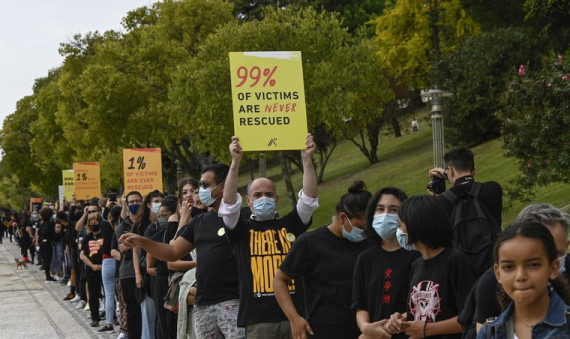
Dehumanising people as victims can also create an urgency that fuels saviourism. This closes down space for discussing potential safeguarding measures, legal advice around identification, or whether those being exploited would, in this instance, benefit from being rescued.
Take what happened to textile workers in Leicester, UK, where modern slavery investigations compelled suppliers to shift location in 2020 and hundreds of people lost their jobs. The investigations might have been well meaning, but they focused on identifying modern slavery rather than on why the workers were there or what their alternatives were.
They also left the use of exploitative business practices unexamined, omitting the fact that, in this economy, decent work in clothing factories is nearly impossible to achieve. The result? Hundreds of workers were left unprotected and jobless, and some ended up in even worse working conditions than before.
Sometimes rescue comes with public identification, which can lead to terrible outcomes. This can be personal, as when sex workers are outed to their communities, or legal, as when there is no firewall between the immigration authorities and support, employment, health or education environments.
In the UK, data-sharing agreements with the Home Office are held by nearly all bodies likely to encounter people who disclose severe exploitation. These include the NHS, the police, the Gangmasters and Labour Abuse Authority, educational institutions, banks and even the Salvation Army, a Christian charity contracted to deliver the government modern slavery victim care system.
People are routinely referred to the National Referral Mechanism (NRM), the UK's system for identifying modern slavery cases, without understanding data sharing agreements with the Home Office and the subsequent risk of exposure to immigration enforcement and deportation.
Rejecting victimhood
While international legal frameworks and definitions still revolve around the term 'victim' (of human trafficking), efforts to engage alternative language and reject sensationalism have expanded globally. Civil society has led on these initiatives. Despite the risks of tokenism, the shift towards 'survivor engagement' entails a tangible shift in the dynamics of a sector challenged by whiteness and saviourism.
Many in civil society promote 'survivor' over 'victim' on the grounds that it conveys resilience and agency, in preference to 'victim'. This new term has found its way into high-level guidance, such as in the Organisation for Security and Cooperation in Europe's Code of Practice for Ensuring the Rights of Victims and Survivors of Human Trafficking.











No comments: