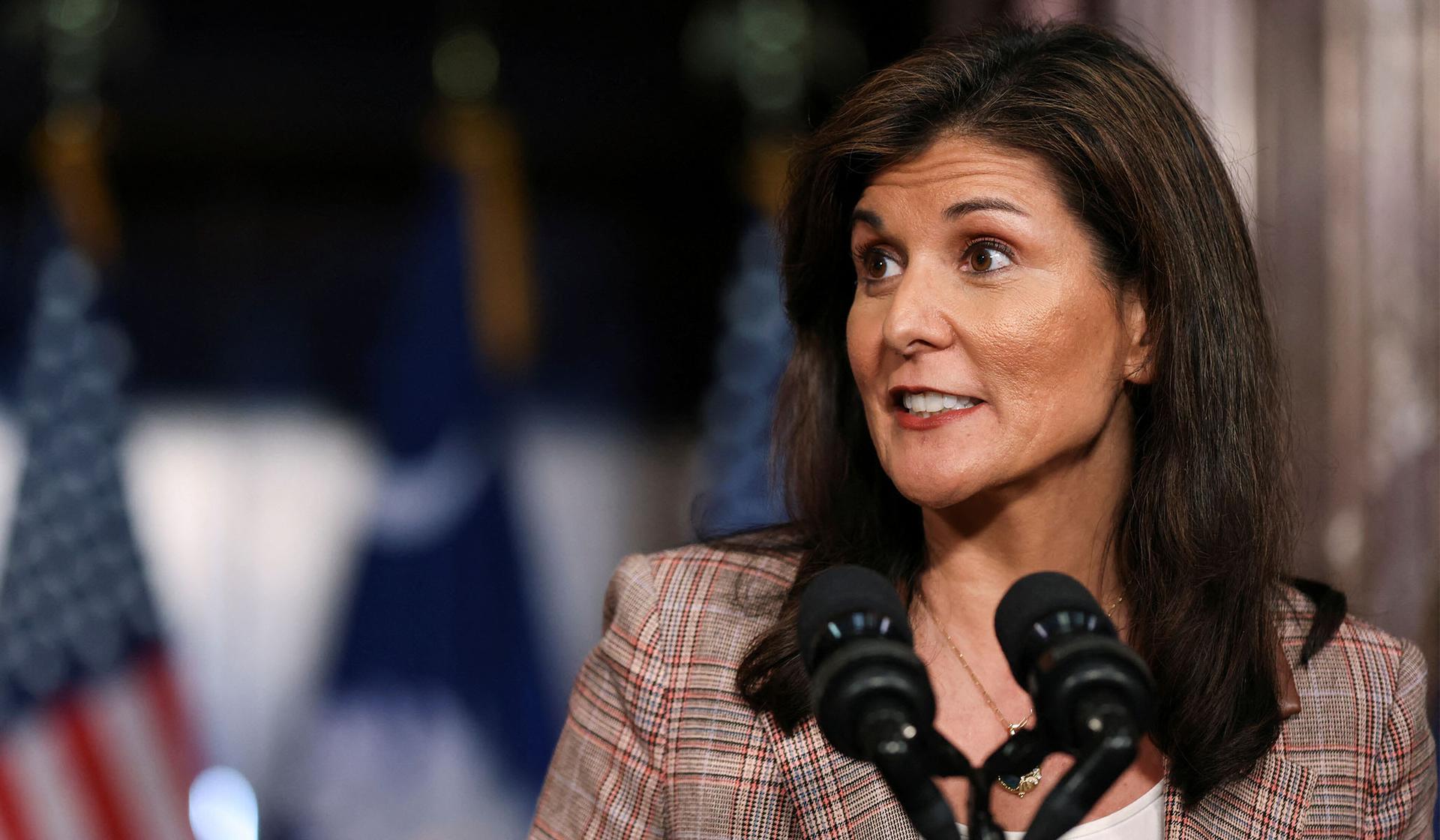
Nikki Haley has momentum but it's unclear whether her fight against Ron DeSantis for second place in the primary will result in anything more than that — second place.
In South Carolina, Haley's home state, she sits in second place with 22 percent, according to a new CNN poll. Trump leads the race in the Palmetto State with 53 percent support among likely Republican primary voters, while DeSantis sits in third with 11 percent. South Carolina senator Tim Scott trails behind at 6 percent.
In Iowa, Haley and DeSantis are tied in second place at 16 points each, according to a new Des Moines Register/NBC News/Mediacom Iowa Poll. That's a ten-point surge for Haley among Iowans since the first poll was conducted in August. Meanwhile, DeSantis saw a three-point drop over the same period.
With polls showing Haley in second place in the three early primary states, Haley's campaign told NR it's "time to start talking about a two-person race, one man and one woman."
But J. Ann Selzer, a pollster who oversaw the recent Iowa survey, told the Des Moines Register that while Haley is rising and DeSantis is holding on for second place, "both of them are on ground that you could only describe as shaky compared to the solid ground that Donald Trump stands on."
"This is a good poll for Donald Trump," Selzer told Axios. "For all the things that happened between the last poll and now, he's still the dominant player in the field, and his standing has, in fact, improved from August."
Strategists I spoke to offered conflicting views about the importance of the fight for second-place.
"Right now I'd want to be Donald Trump," Republican strategist Ryan Williams told me when I asked if he'd rather be Haley or DeSantis. "He's going to win. It's almost like we're having a discussion about this race for the sake of having a discussion."
"Trump is way up. Voting starts in a matter of several weeks and it's really a fight over a distant second place at this point," he said.
It remains to be seen if voters will consolidate around DeSantis or Haley as other candidates drop out, but Williams notes there's no guarantee that DeSantis supporters would support Haley if he dropped out, or vice versa.
"She's running as a different type of candidate than he is," he said, adding that overall there is not really a desire for change in the party in a way that would topple Trump.
"Like if a meteor came out of outer space and hit Trump, that might change the trajectory of the race. But at this point, there's no evidence that anything he does is going to shake enough voters off him to cause him to lose," he said, noting that Trump has largely remained steady despite avoiding debates, getting indicted several times, and insulting the leader of Israel in the midst of a war.
But NR's Noah Rothman argues that the Iowa poll "does not leave its careful readers with the impression that Trump has already put the race in Iowa away." He notes that "less than one-third of the Republican caucus electorate in Iowa is Trump or bust. Meanwhile, 54 percent of likely GOP primary voters in Iowa are telling pollsters they're still willing to be convinced."
So, we're left with a conundrum. Outside Trump, DeSantis is clearly the candidate with the most appeal to the Republican Party's MAGA-flavored populist voters. But DeSantis's efforts to persuade the party's most pro-Trump contingent to abandon the front-runner aren't succeeding. What's more, those efforts have come at the cost of creating a space for another candidate to strike a real contrast with the former president, thereby appealing to voters looking for exactly that kind of contrast. But while Haley's efforts to consolidate the Reaganite wing of the GOP to rally around her campaign are bearing fruit, that coalition is a remnant that is likely too small to ultimately dethrone Trump.
Nicole Schlinger, an Iowa-based Republican consultant, said Haley and DeSantis each have their own advantages: While Haley has the momentum from a polling perspective, she does not have the organizational apparatus that DeSantis has.
"Would I prefer to have momentum? Certainly. But I think both of them have both advantages and challenges," she said.
She suggested that Trump has hit his ceiling, noting he gained just one percentage point between August and October despite significant money and effort expended. His lead is "enough to win in Iowa, but to me the door's not shut, but it is closing for these candidates to beat him."
DeSantis, for his part, has been hurt by expectations that were set "way too high" when he entered the race, she suggested. "I would try to change the narrative and say that this is Trump's race to lose."
Haley and DeSantis will face off on the debate stage for a third time next week in Miami. Tim Scott, Vivek Ramaswamy, and Chris Christie have said they all met the requirements to appear on the debate stage as well.
Trump, who chose not to participate in the first two debates, is not expected to appear this time either.
In order to qualify for the debate, candidates are required to reach 4 percent or higher in two national polls, or 4 percent in one national poll and two different early primary state polls. Additionally, candidates are required to hit a donor threshold of at least 70,000 unique donors, including at least 200 from 20 or more states.
Asked whether the debate next week matters at this point in the race, Schlinger said, "I believe in elections, and so while votes have not been cast, it always matters."












No comments: