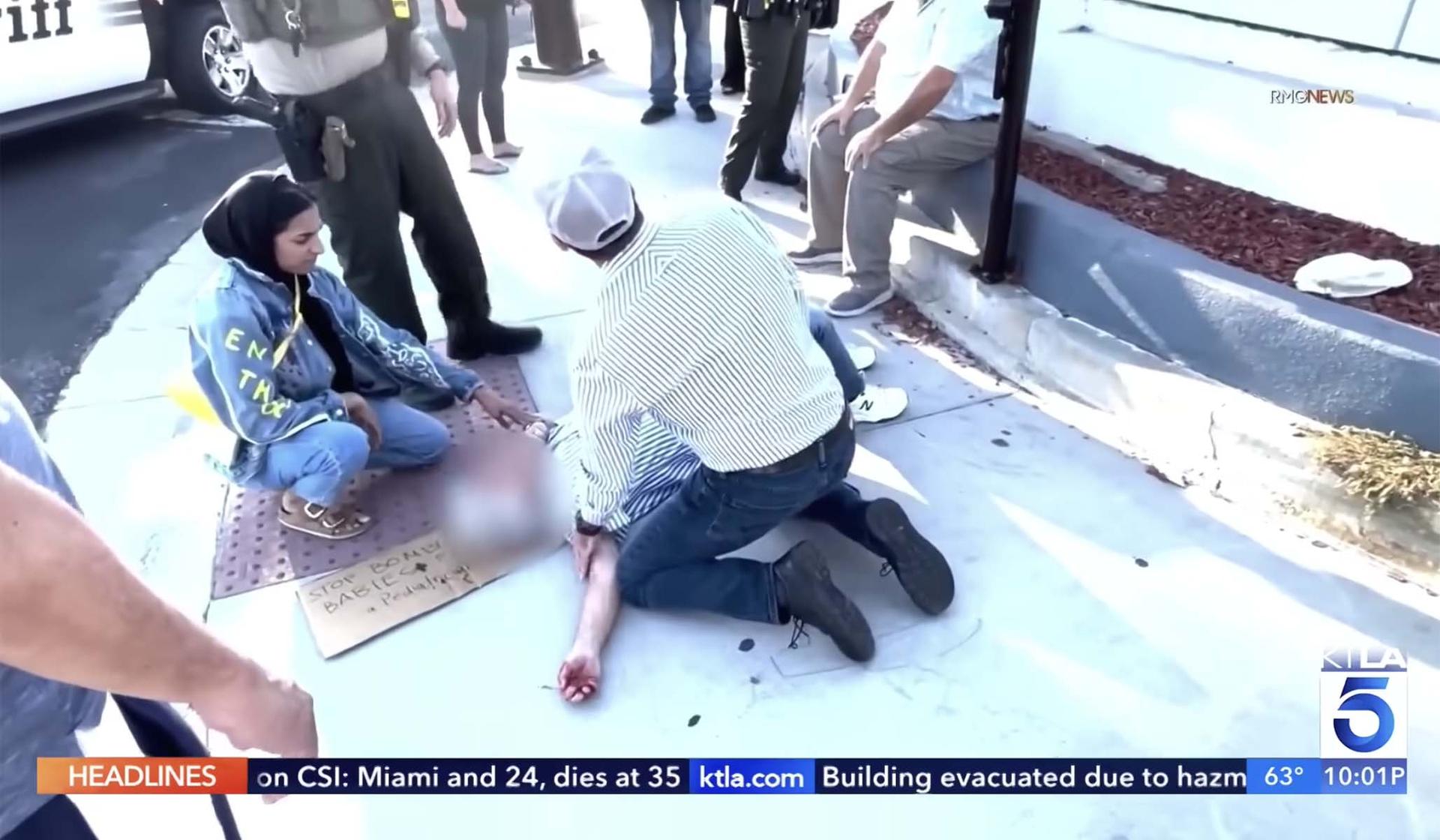
Except . . . this wasn't random violence. Paul Kessler went to a demonstration seeking to exercise his God-given, constitutionally protected rights to assemble and speak, and somebody on the other side felt entitled to knock him around and ended up killing him. This should horrify and outrage us. Kessler was no threat to anyone, and he did nothing wrong. That could have happened to any of us.
(I would note that in one of the short snippets of video of the aftermath of the assault, a woman wearing a headscarf and 'FREE PALESTINE' jacket kneels in concern to check on Kessler. You cannot determine who is a good and kind person just by looking at them or knowing their political beliefs.)
A whole lot of things happen in this world every day, and the news media, at least in its more traditional forms, only has so much space and time to tell you about them. Even for a news website, there's only so much you can put at the top of the page, and only so much time before it's time to put another news story up there.
We've seen the national news media take a seemingly minor incident or issue and turn it into a sustained drumbeat, with every angle explored. Howell Raines of the New York Times used to call it "flood the zone" coverage; in 2002 and 2003, Raines turned the men-only Augusta National Golf Club and its Masters tournament into an issue that received nearly daily coverage in the Times sports page. For some readers, this was no doubt an important crusade for women's equality. For quite a few others, it was indicative of how the Times sports page was much more interested in politics, sociology, and business than, you know, sports.
We've also seen what I characterize as "check the box" journalism — often a wire-service story, run on page A5 of the newspaper, with no attention from the editorial board or op-ed columnists. Just enough coverage of an issue, controversy, or event to dispel claims that the publication or news organization ignored the story entirely. (You may recall that one correspondent whose beat focused almost exclusively on the issue of abortion who declared that the butchery of Kermit Gosnell was merely a "local crime story" up in Philadelphia.)
On paper, the homicide of Kessler is a local crime story. But then, so are mass shootings and attempted mass shootings. So are threats to abortion clinics. Almost no controversy on a college campus even rises to the level of a law being broken — it's often some student or group of students insisting they "felt threatened" by the presence of a speaker, not by any actual verbal or written threat. Lord knows, we get a lot of coverage of hate crimes. (A whole bunch of those turned out to be hoaxes — some guy maintains a database of hate-crime accusations that are proven false here, and he's up to 487 examples.)
Sometimes we're told that a local crime is evidence that there is need for a "national conversation," or that a particular event has "key symbolism" or "troubling implications" for some broader national controversy, or there are "broader lessons for all of us." (The "broader lesson" almost always is some version of, "You should vote for Democrats.") The wannabe mad bomber Cesar Sayoc was evidence that Donald Trump was "radicalizing a generation of angry young men." But apparently, there weren't any broader lessons to be learned from James Hodgkinson's shooting up a baseball field of congressional Republicans in 2017. That maniac couldn't possibly have been radicalized by any of the political leaders he admired; apparently that attempted mass-assassination was just a bad thing that happened, with no broader lessons or troubling implications.
This morning you're going to see a lot of headlines that amount to "Donald Trump continues to say outrageous and crazy things in his court case." I'm not saying that's not news, but it's not exactly surprising, is it? And yet, as of this writing at 8:25 a.m. EST this morning, the top 14 items on the news-aggregating site Memeorandum are about Trump.
If newsrooms wanted to make the name Paul Kessler famous, they could. He could be depicted as a martyr to free speech and the First Amendment, a grim reminder that standing up for what you believe in in the United States of America in 2023 still includes a small risk of suffering violence at the hands of some punk and dying prematurely. You might even see him as a martyr for the cause of Israel, and evidence that the current opponents of Israel aren't just objecting to what they perceive as an excessive use of military force and too many Palestinian civilian casualties. There's a murderous rage lurking in the hearts of some of those anti-Israeli protesters out there.
I'll be pleasantly surprised if the murder of Paul Kessler does prompt some "flood the zone" coverage or a national conversation. I doubt it will, and I think we all know why it is unlikely. The voices of the mainstream media aren't exactly full-throated fans of the angry young folks denouncing Israel and chanting "from the river to the sea." But those protesters are usually young progressives, and the middle-aged liberals who largely populate those news institutions are really comfortable confronting those on the right and really uncomfortable confronting those on the left. And they have good professional reasons to feel that way. Over at the New York Times, running an op-ed by Arkansas GOP senator Tom Cotton is a firing offense if it makes enough young staffers mad. But you can literally praise Adolf Hitler on social media and keep your job covering the Gaza Strip for the Times.
In most newsrooms, being pro-life is an extremist position, but being "anti-Zionist" is not.
In my world, "I'm anti-Zionist" is code for, "I'm antisemitic, but prefer a more socially acceptable label for my irrational demonization of Jewish people and the world's lone Jewish state." (The notion that allegedly respectable intellectuals and elites who insist they merely oppose Israeli policies might actually be driven by much darker, much vaster and more sinister ambitions, popped up here.) These folks might offer some check-the-box tsk-tsking of Hamas, but they all agree that Israel should not exist as a Jewish state. And just like their chant, "from the river to the sea," they never quite get around to elaborating what happens to all the Israelis currently living there.
Put another way, we have a term, "anti-Zionism," which describes the allegedly respectable and allegedly not-that-controversial belief that Israel, a democratic country that has been right there for 75 years, should not exist.
Pick any other country. Imagine if tomorrow, your neighbor suddenly told you that he absolutely detested the government of Guatemala, and argued that Guatemala had no right to exist, and that someday, all the land between Mexico, Belize, El Salvador, and Honduras would be "free." Imagine him marching around, chanting, "From the Gulf of Honduras to the Pacific, all of Guatemala is horrific!" Or he suddenly espoused similar views about Belgium, or South Korea, or any other country.
You would likely conclude your neighbor was a maniac. Who the hell runs around seething with revulsion at some far-off democratic country?
But when college professors, college students, activists, and even members of Congress do this about the world's only Jewish state, we all act like it's normal.
Common is not a synonym for normal.
ADDENDUM: My fellow Washington Post columnists and I chew over the state of the 2024 presidential race, and the surprisingly good odds for Donald Trump, at least in the current moment.












No comments: