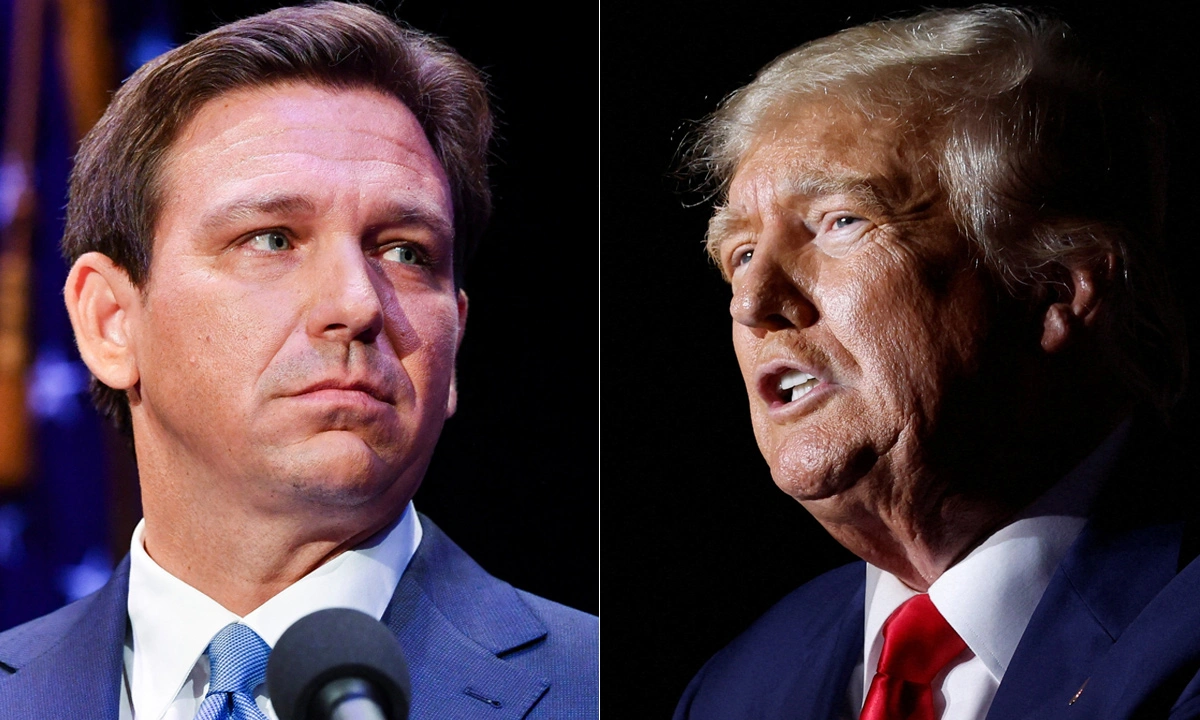
Former president Donald Trump hit the campaign trail over the weekend for the first time this cycle and quickly fell back into old patterns, taking shots at his leading competitor, Ron DeSantis — this time focusing his attacks on the Florida governor's Covid record.
While DeSantis, whom Trump calls "Ron DeSanctimonious," has not officially said whether he plans to run for president in 2024, he is widely considered Trump's most formidable opponent. Naturally, this means the governor has a target on his back.
Trump took aim at DeSantis's Covid response during campaign stops in New Hampshire and South Carolina, accusing the governor of "trying to rewrite history" on his handling of the Covid-19 pandemic in the Sunshine State.
"There are Republican governors that did not close their states; Florida was closed for a long period of time," Trump said.
For his part, DeSantis appeared unbothered by Trump's comments.
"When you're an elected executive, you have to make all kinds of decisions. You got to steer that ship. And the good thing is that the people are able to render a judgment on that — whether they reelect you or not," DeSantis said when asked to respond to Trump's criticisms.
"And I'm happy to say, you know, in my case, not only did we win reelection. We won with the highest percentage of the vote that any Republican governor candidate has in the history of the state of Florida," he added. "We won by the largest raw vote margin — over 1.5 million votes — than any governor candidate has ever had in Florida history."
That massive reelection win was likely due in part to the fact that the Sunshine State returned to "normal" more quickly than most other states during the pandemic, despite Trump's claims.
DeSantis waited longer than many other states to even declare a stay-at-home order, which he officially issued on April 1, 2020. By contrast, California, the first state to issue a stay-at-home order, did so on March 19. Only a handful of states, with more rural populations, never issued such an order, including Arkansas, Nebraska, North Dakota, and Wyoming.
By April 20, DeSantis had already appointed a "Re-Open Florida Task Force," which he tasked with quickly forming a plan to reopen the state. The stay-at-home order expired in early May, and by late September, DeSantis had lifted all restrictions on restaurants and businesses.
If anything, it was Trump who was soft on reopening.
"I told the governor of Georgia, Brian Kemp, that I disagree strongly with his decision to open certain facilities," Trump told the White House press corps while standing next to his Covid adviser, Dr. Anthony Fauci, on April 22.
Despite criticizing Kemp's decision to reopen small businesses, gyms, salons, and restaurants, Trump later endorsed DeSantis's reopening plan when the Florida governor visited the White House on April 28.
In October 2020, Trump actually lauded DeSantis's handling of the pandemic during a reelection rally in Ocala, Fla., and called him "one of the greatest governors in our country."
"We had surges, and they went up and they went down, and now you're at your lowest numbers," Trump said at the time. "And you're open and you didn't close, and you're just amazing — right, this guy?"
Now, Trump's unfounded attacks on DeSantis are likely to open the door to criticisms of his own Covid response. While DeSantis rejected "Fauci-ism," Trump zealously went along with a number of Fauci's pandemic-related recommendations.
In a press release from his 2020 presidential campaign, Trump even drew attention to one of Fauci's comments in which he said that Trump supported a recommendation from Fauci and Dr. Deborah Birx, the White House coronavirus response coordinator, for a 30-day lockdown early in the pandemic, even when others didn't.
"Obviously there were people who had a problem with that because of the potential secondary effects," Fauci said. "Nonetheless, at that time, the president went with the health recommendations, and we extended it another 30 days . . . I can just tell you the first and only time that I went in and said we should do mitigation strongly, the response was yes, we'll do it."
Mike Pompeo's new memoir also details how Trump was soft on China at the start of the pandemic, despite the country's lack of transparency about the virus's origins and failure to immediately alert the international community to the threat. Trump allegedly told the then–secretary of state to "shut the hell up for a while" about Beijing's Covid response to keep from upsetting Chinese president Xi Jinping.
"China has been working very hard to contain the Coronavirus. The United States greatly appreciates their efforts and transparency. It will all work out well. In particular, on behalf of the American People, I want to thank President Xi!" Trump tweeted at the time.
Pompeo said Trump felt he had to play nice with Beijing while the U.S. relied on Chinese health-care products.
Meanwhile, vaccines are likely to feature prominently in the Trump–DeSantis Covid showdown. DeSantis placed himself to the right of Trump on the issue of vaccines in December when he announced plans to empanel a grand jury to investigate "any and all wrongdoing" involving Covid-19 vaccines in the state. DeSantis did not elaborate on what "wrongdoing" the grand jury would investigate, and most health officials agree that the Covid-19 vaccines from Pfizer and Moderna are safe and effective at preventing serious illness or death from Covid-19, though concerns have emerged about an increased risk of stroke among elderly vaccine recipients and an elevated risk of myocarditis among young, male recipients.
Now, Trump allies are reportedly building a file of "opposition research" on DeSantis that shows the governor's support for the vaccine in its early days, the New York Times reported. The research includes footage of DeSantis taking delivery of some of the first vaccines in America and "news B-roll of DeSantis presiding over vaccinations of elderly people."
While Trump previously touted his administration's efforts on the vaccine, known as "Operation Warp Speed," as a great achievement, he has since sought to distance himself from the jabs.
Trump's team is also working to identify other areas of weakness for DeSantis. The former president's advisers reportedly believe that the former congressman's track record of voting to cut funding for Social Security and Medicare is another area ripe for criticism, per the Washington Examiner. DeSantis voted for three nonbinding resolutions between 2013 and 2015 that called for raising the retirement age to 70 and reducing benefits for millions of earners.
Trump, meanwhile, recently released a video calling on Republican lawmakers not to make cuts to the entitlements package as they begin negotiations with President Biden and Democrats over a measure to raise the debt ceiling.
"Under no circumstances should Republicans vote to cut a single penny from Medicare or Social Security," Trump said. "Cut waste, fraud, and abuse everywhere that we can find it, and there is plenty of it. . . . But do not cut the benefits our seniors worked for and paid for their entire lives. Save Social Security. Don't destroy it."
One GOP campaign operative told the outlet that the plan to attack DeSantis on entitlements is a "can't lose" strategy for Trump.










 Megyn Kelly -> Pete Hegseth responds to 2017 rape accusation. 🔥 vol. 3, issue 13 | December 6, 2024 Quick Hits All the news you need in...





No comments: