with John McCormack & Brittany Bernstein
|
Wednesday, November 02, 2022
|
|
|
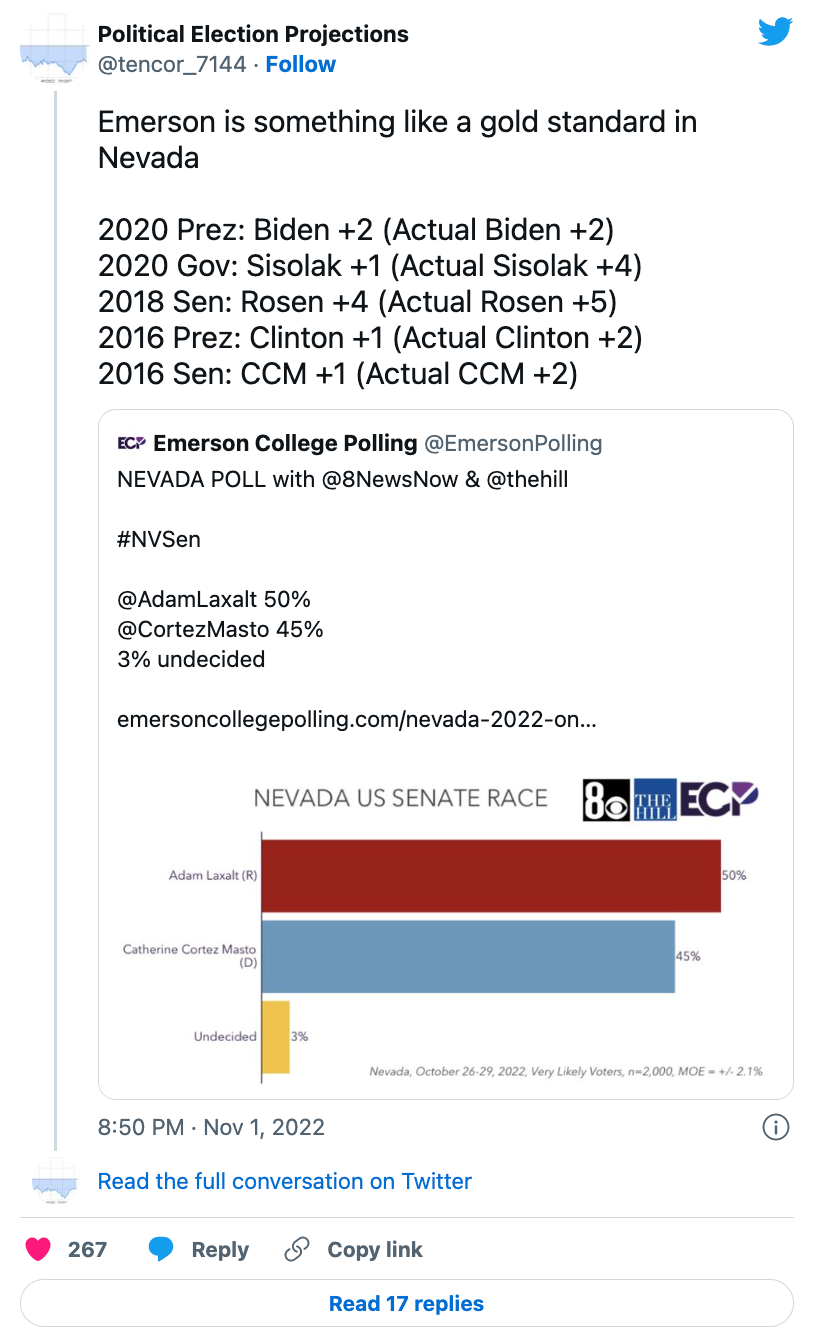
With less than a week left in the 2022 campaign, there are at least five states with toss-up Senate races. In four of those five contests most likely to determine control of the upper chamber, incumbent Democratic senators are playing defense, while the fifth (Pennsylvania) is a battle for an open seat currently held by a retiring Republican. 1. NEVADA: Republican Adam Laxalt leads Democrat Catherine Cortez Masto by 1.9 points. Laxalt got good news on Tuesday when two new polls — one by Emerson and the other by Susquehanna — each showed the Republican leading Cortez Masto by five points. Nevada is one state where polling averages have underestimated Republicans in recent years, but Emerson nailed the presidential, Senate, and gubernatorial races in the state in 2016, 2018, and 2020. |
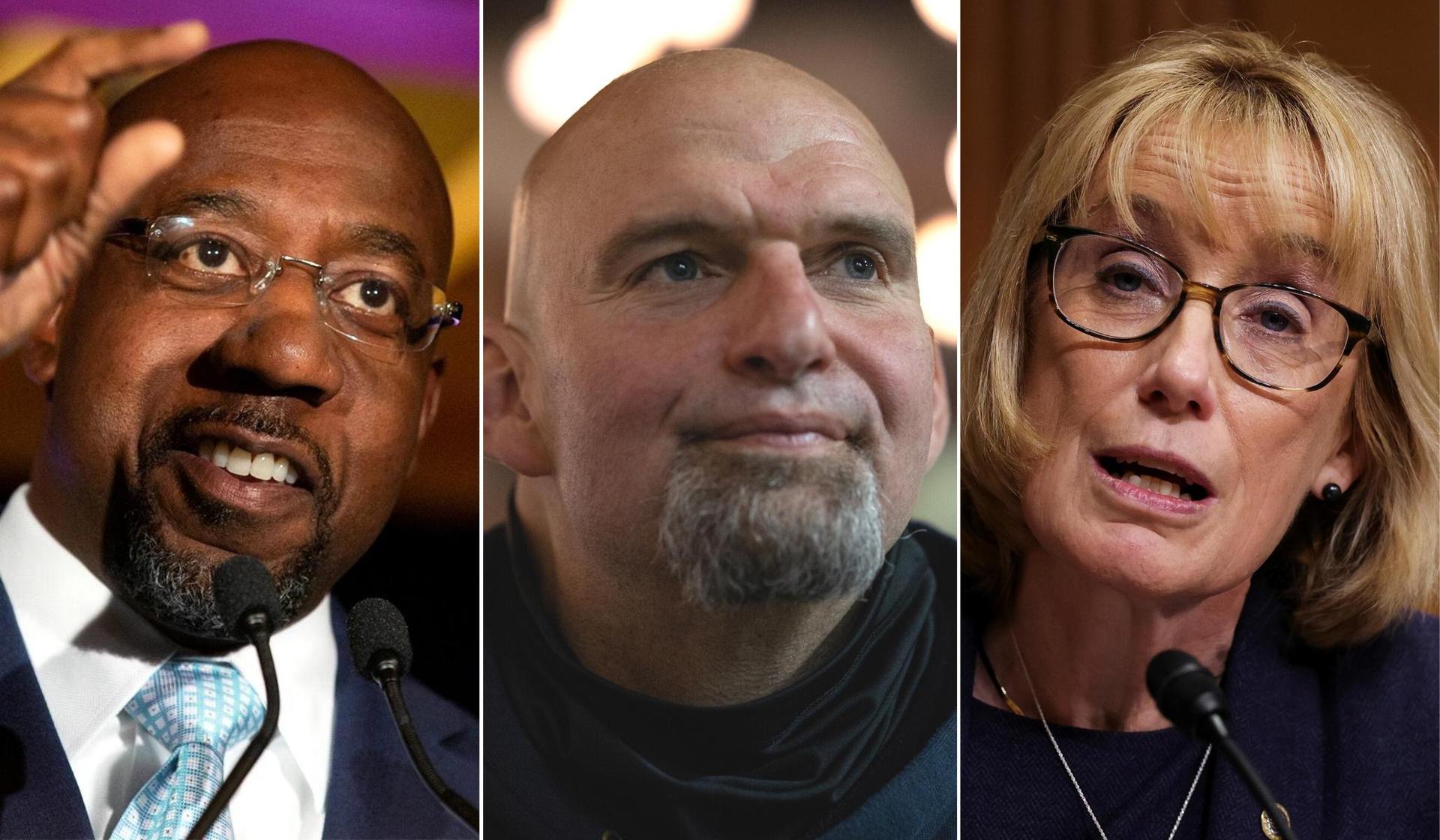
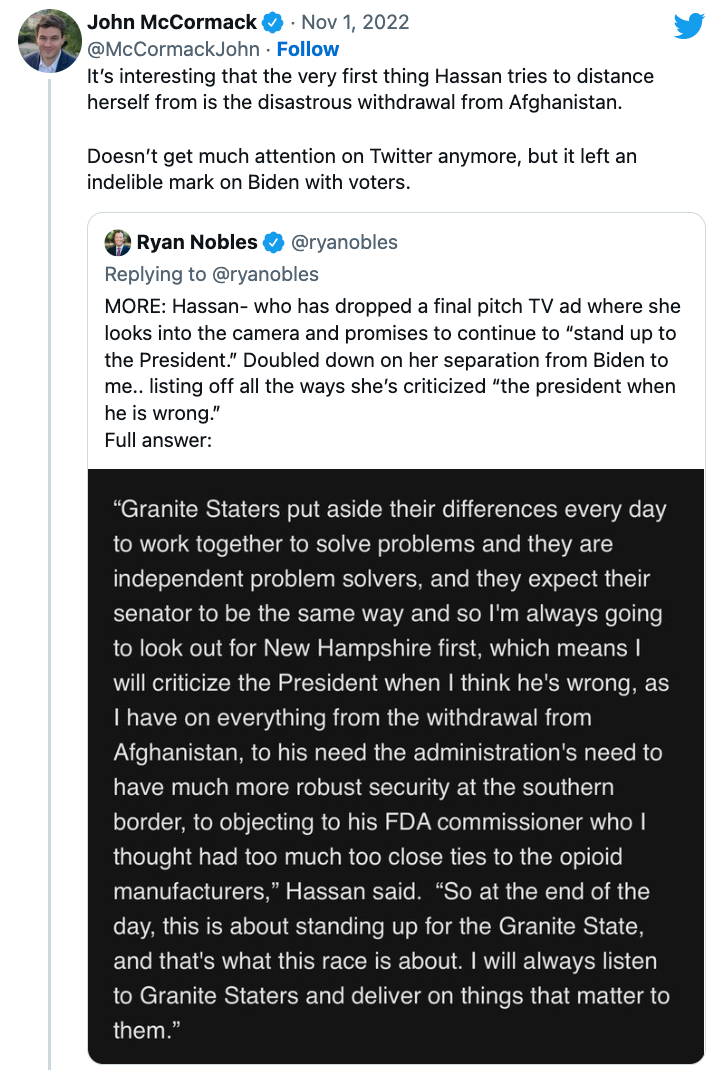
2. GEORGIA: Republican Herschel Walker leads Democrat Raphael Warnock by 1.6 points. Remember that in Georgia statewide candidates need to get 50 percent of the vote to avoid a runoff election. GOP governor Brian Kemp seems very likely to coast to victory — he leads Abrams by 7.6 points in the RealClearPolitics average. There's a chance Kemp's coattails could drag Walker over the finish line on November 8, but the likeliest outcome remains a runoff election in December. 3. NEW HAMPSHIRE: It's looked for most of the year like incumbent Democrat Maggie Hassan was heading to reelection. The strongest potential GOP opponent, Chuck Morse, lost his primary to Don Bolduc in September. But now it's looking like a tight race, with Bolduc trailing Hassan by just one point. On Tuesday, a poll released by St. Anselm College — a pollster that nailed the 2020 New Hampshire Senate and presidential races — showed Bolduc leading Hassan 48 percent to 47 percent. And it's clear that Hassan is running scared. Her closing message is a TV ad highlighting issues on which she criticized President Biden: |
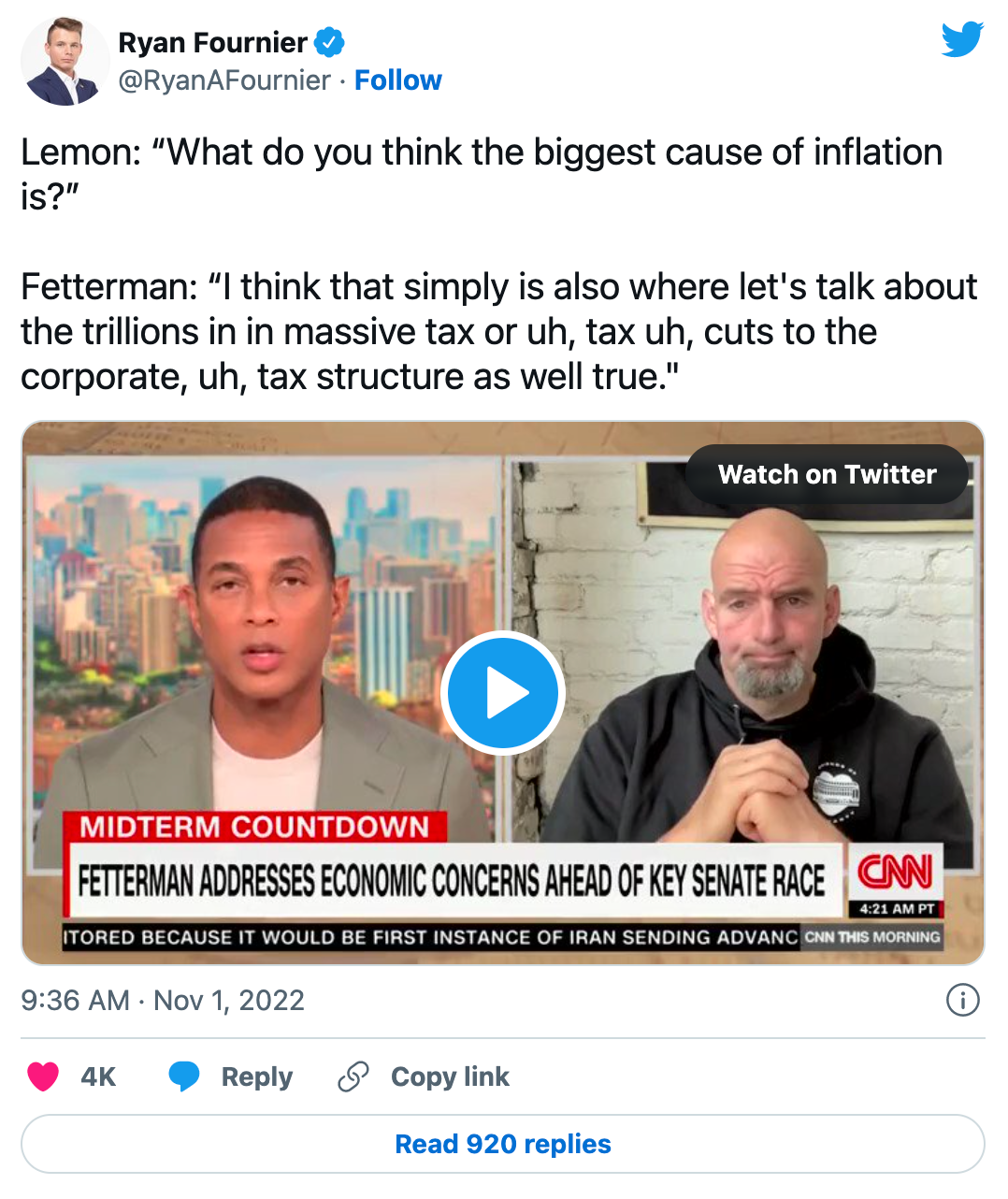
4. ARIZONA: Republican Blake Masters trails Democrat Mark Kelly by 2.3 points in the RCP average. In the gubernatorial race, meanwhile, Republican Kari Lake leads Katie Hobbs by 2.8 points. The disparity in the two races is probably somewhat due to Kelly's relative strength as a candidate. Kelly is a former astronaut and the husband of former congresswoman Gabby Giffords, while Hobbs is an uncharismatic secretary of state who has dodged debates with Lake. A wave could still sweep both Republicans into office. 5. PENNSYLVANIA: Democrat John Fetterman is clinging to a 1.2-point lead over Republican Mehmet Oz, but only one* of the polls in the RCP average was conducted entirely after Fetterman's debate performance, which raised serious questions about his mental fitness to serve as U.S. senator. Fetterman has been doing interviews on live TV (mostly with friendly interviewers), but those interviews have only demonstrated that the debate wasn't simply an off night for Fetterman. |
(*That poll, by InsiderAdvantage, showed Oz leading by three points. Another poll, released Wednesday by Monmouth but not included in the RCP average, showed Fetterman up by four points, but Monmouth has a very unusual approach to polling: Rather than simply asking voters one question about which candidate they'll choose, Monmouth asks two separate questions about voters' likelihood of voting for each of the candidates. We'll see how this new model fares after next Tuesday.) As a general rule, I view any race in which the candidates are separated by three points or less in the RealClearPolitics average of polls as a toss-up. In the nine congressional-election cycles dating back to 2004, there are only one or two Senate races in which a candidate was leading by more than three points in the RCP average on Election Day but lost: Maine in 2020 and North Dakota in 2012. But there are many examples of a candidate leading by less than three points but losing. There I see a couple of exceptions to the three-point rule in 2022. Wisconsin, where Republican senator Ron Johnson holds a three-point lead, is in play but clearly leans toward Johnson. His vote share has been 50 percent or higher in four of the last five polls, and FiveThirtyEight gives him a four-in-five chance of winning. In Ohio, Republican J. D. Vance is leading by just 2.2 points, but given the partisan tilt of the state and how polls have underestimated GOP candidates in recent years, no one thinks it's a true toss-up. While Mitch McConnell's super PAC has spent more than $30 million boosting Vance, national Democrats have given up on the race. FiveThirtyEight gives Vance a four-in-five chance of winning. There are also a couple of states just outside the three-point margin: Democrat Patty Murray has a 4.3-point lead in Washington state, and Republican Ted Budd has a 4.5-point lead in North Carolina. They're both probably fine, but it's worth keeping those states on your radar in the final days of the campaign. |
|
|
Republicans have a chance to defeat the chair of the DCCC for the first time in 40 years. Representative Sean Patrick Maloney finds himself in a closer-than-expected race for New York's 17th congressional district against state assemblyman Mike Lawler. Last week, the Cook Political Report shifted the race from "lean Democrat" to "toss up." That the newly redrawn district is competitive has come as a shock, given that President Joe Biden won the area by ten points in 2020. I caught up with Lawler this week: |
"This would certainly have historical significance, but I think would certainly be a harbinger of what is to come on election night, if we're able to flip a district like this, that is labeled a D+3, by Cook," Lawler told National Review. "They've now put this in the toss up category and certainly if we can win here, we're gonna have a very, very good night across the country." He said three things have helped make the race so tight: his time spent on the campaign trail with targeted messaging about issues that matter, redistricting, and a "significant amount of money" spent by outside groups. "Whether you're talking about inflation, whether you're talking about crime, whether you're talking about education, those are what folks are concerned about. And in this district, it's a pure suburban district. There's really no cities here." The district is "very much a blue-collar working class" area, where 50 percent of households have a cop, firefighter, first responder or veteran living there, he said. Lawler believes his messaging on public safety and cost of living has been resonating in the area, where he said national issues are "amplified" in many respects. Redistricting means that Maloney only currently represents 25 percent of the residents that will be in the newly drawn district, stripping him of the typical incumbent advantage. Lawler represents about 20 percent of the district in the state assembly. |
|
|
RealClearPolitics POLLING AVERAGES |
Generic congressional ballot: Republicans +2.8 Republican Senate candidates lead: Ohio: R+2.0 (Vance 47.3%, Ryan 45.3%) North Carolina: R+4.5 (Budd 48.5%, Beasley 44.0%) Nevada: R+0.4 (Laxalt 46.3%, Cortez Masto 45.9%) Wisconsin: R+3.3 (Johnson 50.8%, Barnes 47.5%) Georgia: R+1.6 (Walker 47.4%, Warnock 45.8%) Democratic Senate candidates lead: New Hampshire: D+2.3 (Hassan 48.3%, Bolduc 46.0%) Pennsylvania: D+1.2 (Fetterman 47.4%, Oz 46.2%) Arizona: D+2.5 (Kelly 47.1%, Masters 44.6%) |
|
|
The Cook Political Report recently shifted a number of races in favor of Republicans, including the Arizona Senate race, which was moved back to the "toss up" column just one month after it was designated "lean Democrat." The move reflects "a spate of tightening private polling that has left Democrats worried about one of their strongest incumbents," Cook explained. Cook also shifted three gubernatorial races: Michigan governor Gretchen Whitmer's race shifted from "likely Democrat" to "lean Democrat." New York governor Kathy Hochul's race shifted from "solid Democrat" to "likely Democrat." Connecticut governor Ned Lamont's race shifted from "likely Democrat" to "solid Democrat." And in ten House races, "all in very blue states and in districts Biden carried by between eight and 20 points in 2020": California Democrat Josh Harder's race moved from "likely Democrat" to "lean Democrat." Illinois Democrat Sean Casten's race also moved from "likely Democrat" to "lean Democrat." California Democrat Julia Brownley's race shifted from "solid Democrat" to "lean Democrat." California Democrat Katie Porter's race moved from "lean Democrat" to "toss up." Illinois Democrat Lauren Underwood's race shifted from "likely Democrat" to "lean Democrat." New Jersey Democrat Andy Kim's race also shifted from "likely Democrat" to "lean Democrat." The open race for New York's third congressional district shifted from "lean Democrat" to "toss up." The open race for New York's fourth congressional district also shifted from "lean Democrat" to "toss up." New York Democrat Joseph Morelle's race moved from "solid Democrat" to "likely Democrat." The open race for Oregon's fifth congressional district shifted from "toss up" to "lean Republican." |
|
|
• A new CNN poll found Republicans leading Democrats 51 percent to 47 percent on the generic ballot, but Jim Geraghty suggests there's reason to believe Republicans will overperform that margin. In 2014, Democrats led Republicans 47 percent to 46 percent in the final CNN poll, but Republicans ultimately led the total number of House votes cast by 5.7 percentage points over the Democrats. |
In other words, that cycle, Republicans over-performed the final CNN poll's margin by 6.7 percentage points. If history repeats itself, Republicans will lead the total number of House votes cast by almost 11 percentage points over the Democrats. I doubt the margin will be quite so large, but for Republicans hoping for a substantial House majority, these new CNN numbers are enormously encouraging. |
• Dan McLaughlin offers this recap one week out from Election Day: "Among the Republicans still locked in reasonably close races, nearly all of them have had to come from behind; Republicans who had non-trivial leads going into September have nearly all put away their races by now." • While Covid-19 is no longer a top issue for most voters, the pandemic continues to color much of our politics, Michael Brendan Dougherty writes: |
Voters currently cite the economy and inflation as their top issues, far outranking abortion and guns. Crime is often second or third in the priority list of voters, according to all pollsters. This is all downstream of Covid. We are still climbing out of our pandemic response, and our politics reflect that. The 2020 election was about Donald Trump. The 2022 election is about where you stood on Covid, and the aftermath. |
• California Republicans may come to regret tapping into voter enthusiasm last summer in a failed attempt to recall Governor Newsom, rather than releasing that political energy in the midterms, Dan McLaughlin says. New York gubernatorial candidate Lee Zeldin is running a tighter race than expected, bolstered by New Yorkers' pent-up anger at how the state managed the pandemic, crime, and the economy. • New York's failed Democratic policies could actually help keep Governor Kathy Hochul in office, as they have led to a record number of New Yorkers fleeing the state. The race is closer than expected, Philip Klein writes -- "so close, that the margin might end up being explained by Republican voters who gave up on the state as a lost cause and abandoned it already." |
|
|
|











 Megyn Kelly -> Pete Hegseth responds to 2017 rape accusation. 🔥 vol. 3, issue 13 | December 6, 2024 Quick Hits All the news you need in...




No comments: