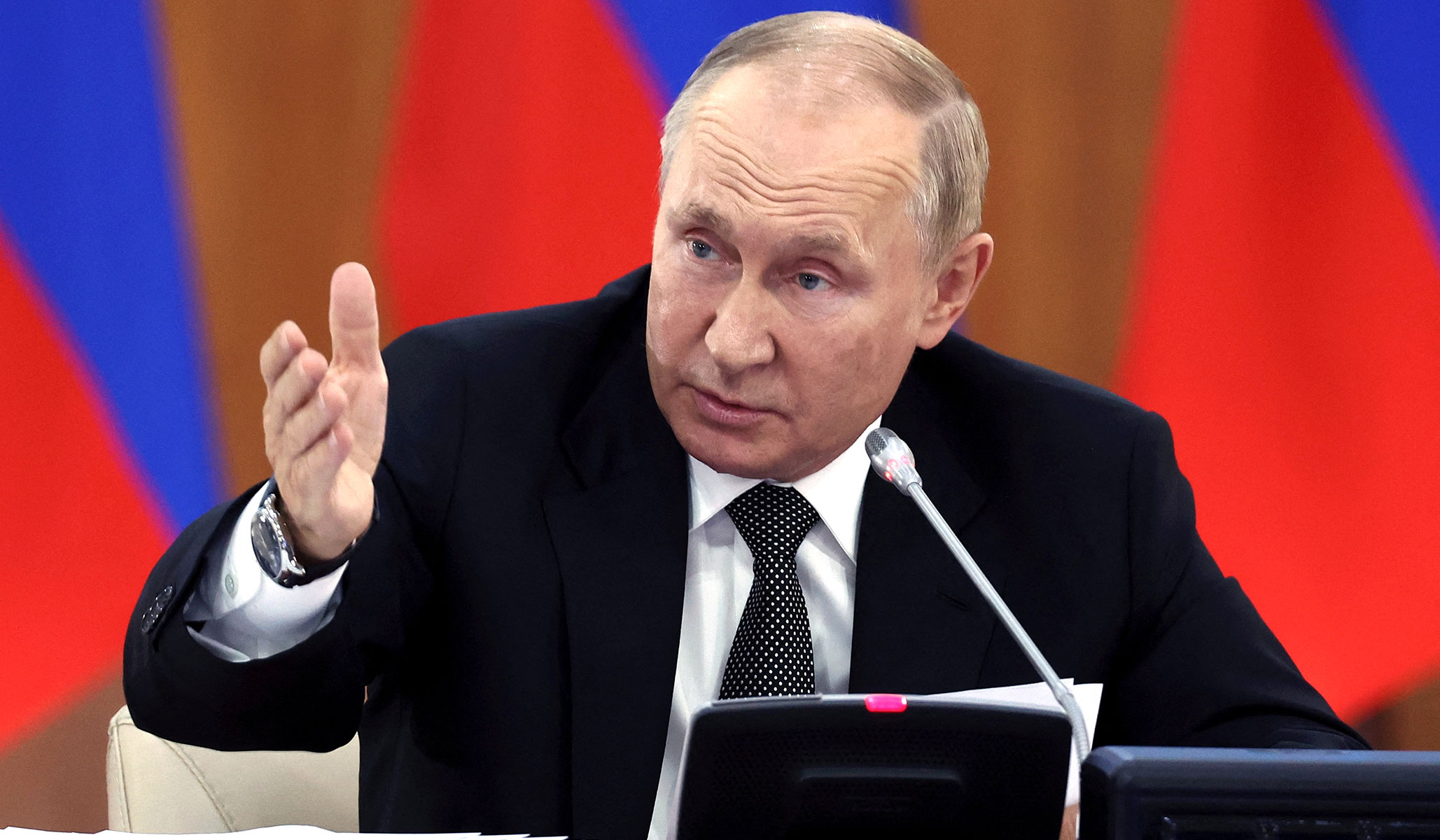
 Dear Weekend Jolter, "Revisionist powers that start to worry that they are peaking . . . sometimes do some fairly rash things." Hal Brands, at Johns Hopkins, issued this warning during a think-tank talk last month promoting his new book on China with Michael Beckley. Their premise is that rising powers are most dangerous when events turn against them and they see their window of opportunity narrow, and that we are witnessing such a moment. Brands loosely applied the description to Russia as well. Ukraine's ground-gaining counteroffensive over the past week certainly raises the question of what a cornered dictator, seeing his chance to assert hemispheric dominance fade, might do. As Jim Geraghty observed, "A Russia that is utterly defeated in Ukraine is a wounded dog — desperate, angry, irrational, and capable of lashing out in unpredictable ways that could turn out badly for everyone." This is not to suggest we do anything less than celebrate Ukraine's hard-won gains and pray for a swift and complete victory — one that deters Vladimir Putin from future revanchist adventures and encourages him to while away his twilight years at a Black Sea dacha with aging lieutenants whom he forces to let him win at Risk. Jim's point is that the West should take nothing for granted and prepare for anything — from Putin's possible use of tactical nukes or other unconventional weapons, to an all-out energy war against Europe. Rising criticism on Russian media from pro-war factions, a byproduct of the Ukrainians' battlefield momentum, presents another destabilizing force inside the country. The BBC's man in Moscow detailed the pressure emanating from hawkish circles, cautioning against any confident predictions of Putin's plans and noting, "The Russian president rarely admits to making mistakes. And he rarely makes U-turns." From NR's editorial: What comes next will be critical. The long history of warfare has shown that an army is at its most vulnerable in retreat. The Russians find themselves at a moment of crisis. . . . Rumors are swirling of dissatisfaction in the Kremlin. Vladimir Putin's credibility rests on his aura of competence and the propaganda of Russian victory. Gambling to save face, he may not follow the most prudent course of action. But battlefield defeat could reveal Putin's regime to be very brittle indeed. Whatever the Russians do, the path forward for America is clear. We must redouble our efforts to support a Ukrainian army with a demonstrable will to fight and that has once again proved itself capable of taking the war to the enemy. We must warn Moscow — in public and private — that tactical nuclear weapons would foreclose Moscow's options and the West's ability to negotiate, and would amount to an enormously dangerous gambit whose result cannot be foreseen. And the Biden administration must make clear to wobbly Europeans that they cannot allow a weakened Kremlin — armed only with energy hostage-taking and nuclear saber-rattling — to bully them into surrendering.
Robert Zubrin has similar advice, writing that Putin "must not be given the time" to essentially raise a new army. As for what this year's still-fresh history has taught us, Rich Lowry concludes it's that there's no substitute for hard power, which America has helped provide: Ukraine's cause hasn't gotten any more just or inspiring over the last couple of months; it's gotten better armed. Ukraine couldn't win a straight-up artillery fight with the Russians, and in fact it was losing one in a grinding war of attrition. A HIMARS, or high-mobility artillery rocket system, versus artillery fight, though, is a different matter.
There may be no way to predict what Putin will do next — making the best course of action to limit his options as much as possible. NAME. RANK. LINK. EDITORIALS A thorough recounting of how the Ukrainians gained the upper hand: The Tide Turns in Ukraine California is doing it wrong: The Left's Power Shortage NR's editorial on Senator Lindsey Graham's abortion proposal generated robust internal debate. The editorial is here; dissents can be found here, here, and here; and a concurrence, of sorts, can be found here, as well as here. ARTICLES Michael Brendan Dougherty: The Question for DeSantis Yuval Levin: The Constitution and National Unity Kenin Spivak: The Biden Administration Is Engaged in a Massive Censorship Campaign Nate Hochman: The GOP Race for House Majority Whip Heats Up Nate Hochman: America Really Is an Outlier on Abortion Brittany Bernstein: Democratic Kansas Governor Makes ‘No Apologies’ for School Lockdowns after Teachers’ Union Endorsements Ryan Mills: The Right’s Answer to the ACLU Takes on Leftist Racial Discrimination Charles C. W. Cooke: Biden Can't Pretend Inflation Away Dan McLaughlin: The Shape-Shifting Evan McMullin Caroline Downey: Morse Concedes to MAGA Army Vet Don Bolduc in New Hampshire GOP Senate Primary Jay Nordlinger: Ukraine and the Right Isaac Schorr: Atlantic Writer Angers Museum Curator with ‘Dangerous,’ ‘Unethical’ Inquiry CAPITAL MATTERS Joel Zinberg breaks down how Covid is driving historic declines in longevity: Life Expectancy in the Covid Era The inflation report doesn't get any better on closer inspection. From Jack Salmon: Under the Hood, August's Inflation Numbers Are Ugly LIGHTS. CAMERA. REVIEW. Armond White breaks down the "making history" trope: Making and Breaking Emmy History Dan McLaughlin, from downtown, with the fact-check: The Woman King and the Real History of Dahomey Brian Allen looks for silver linings at a New York show (and has a bit of fun with emojis): Nice Art If You Can Find It at New York's Armory Show FROM THE NEW, OCTOBER 3, 2022, ISSUE OF NR John McCormack: If the Dems Win It All Matthew Continetti: The Woke and the Restless Ari Schulman: The Dirty War over Covid John O'Sullivan: The Queen Lays Down Her Burden Madeleine Kearns: Truss Takes Office, a New Era in British Politics Begins WE'VE INCLUDED SOME WRITING SAMPLES The new issue of NR is out, and you'll want to read, among other offerings, the features by Continetti and McCormack on the possibility of a Democratic upset in the midterms, and its implications. I quote from the latter's: One-party Democratic control of the federal government — unchecked by the Senate filibuster and West Virginia senator Joe Manchin — is now an unlikely but plausible outcome of the November elections. And it's time to start taking seriously what the consequences of that election outcome would be for the country on a wide array of issues in 2023 and beyond. . . . With a House majority and 52 Senate seats, Democrats would have the votes to gut the Senate's legislative filibuster — the long-standing 60-vote rule for passing most legislation. They would no longer need to seek bipartisan support on any matter, and they would no longer be constrained by the moderating influence of Democrats Joe Manchin of West Virginia and Kyrsten Sinema of Arizona. Without needing the votes of Manchin and Sinema, "we could repeal the filibuster and then pass Roe v. Wade into law, voting rights into law," Massachusetts Democratic senator Elizabeth Warren told me recently in the Capitol. "We can get universal child care, tax reform, and more-meaningful gun-safety regulation. . . . Fairer taxes, like the wealth tax on the very richest, become a real possibility." The moderate credentials of Manchin and Sinema are somewhat exaggerated. They both voted for the $2 trillion "Covid relief" bill passed in March 2021 — after the pandemic shutdowns were mostly over and vaccines were available — which is widely recognized to have exacerbated inflation. And Manchin inked a deal with Chuck Schumer to spend an extra $600 billion on Obamacare subsidies and green-energy subsidies in the "Inflation Reduction Act," which will not reduce inflation. But Manchin and Sinema have constrained the Democratic agenda in some meaningful ways. As Manchin correctly pointed out in December, the real ten-year cost of the Democrats' House-passed "Build Back Better" social-welfare bill is $4.5 trillion. So the rest of Build Back Better — the extra $3.9 trillion in spending Manchin and Sinema stopped in 2022 — is probably the minimum that Democrats would pass in 2023 if they held the House and picked up a seat or two in the Senate. How much farther Democrats would go beyond Build Back Better on spending and taxes would depend on the willingness of senators to the left of Manchin and Sinema to pump the brakes on the full Bernie Sanders budget. Senate Democrats wouldn't even need to scrap the filibuster to spend that extra $4 trillion — they could do it under existing rules with a simple majority — but they have made it clear they would get rid of the 60-vote rule if they held 52 Senate seats and a House majority in 2023. In January 2022, every Senate Democrat but Sinema and Manchin voted to override Senate rules in an attempt to pass a sweeping voting bill with a simple majority. Now, congressional Democrats and President Biden are campaigning on scrapping the Senate filibuster to enact a radical federal abortion bill. It's simply untenable for Democrats to carve out exceptions in two areas of policy without effectively doing away with the 60-vote rule for all legislation.
By the time this arrives in your email inbox, it will be Constitution Day. In honor of the occasion, Yuval Levin has an exposition on how the Founding document is, in fact, the solution and not the problem in the struggle for societal solidarity. His conclusions: Conservative constitutional thought should champion the republican cause as an appealing organizing principle more generally. It points toward the shape that a constitutional restoration ought to take: the reinvigoration of Congress as a genuinely legislative body enabling cross-partisan negotiation; the prioritization of steady administration in the reform of the executive branch; an assertive role for the courts in requiring the elected branches to step up to their responsibilities rather than having judges take those over; a restoration of meaningful federalism rooted in a commitment to communal self-rule that balances majority will with minority rights; and an emphasis on responsible citizenship and civic virtue in our engagement with politics. That is what it would mean to pursue a restoration of republicanism to its proper prominence in America's civic vocabulary. And this kind of approach to constitutional restoration stands to offer not only political and administrative benefits but also a practical path toward greater national unity. The Constitution was intended to help our fractious society address its divisions. It offers proven and plausible means for doing so. Yet we have lost sight of those means, and indeed of the possibility that meaningful national unity can be forged at all. That Americans have come to see themselves as hopelessly divided is both a cause and an effect of the constitutional crisis we confront. Today, that hopelessness demands that we call upon the resources of our political tradition. Too many thoughtful Americans now dismiss that tradition as morally hollow. But they have mistaken crude caricatures of our political heritage for the real thing, and so risk denying our society the capacity for recovery. At the heart of our republicanism is an idea of the human being and citizen rooted in the highest traditions of the West: that we are each fallen and imperfect yet made in a divine image and possessed of equal dignity; that individuals are social creatures meant to live together; that living together requires a commitment to pursue the common good; and that this pursuit in a free and therefore diverse society requires of the citizen selflessness, accommodation, restraint, deliberation, and service. That ideal should be the starting point of any constitutional restoration. It calls upon not only our institutions and our elites, but upon every one of us to take on the responsibility of citizenship, and to accept the duties that come with the high privilege of calling ourselves Americans. It gives us each something to do, and gives us all a lot to do together. And we will need to take it seriously if we mean to preserve the blessings of liberty for ourselves and our posterity.
Dan McLaughlin does a deep dive on independent Senate candidate Evan McMullin's long trail of flip-flops: It's not just abortion. Instead of emphasizing his commitment to originalism, McMullin now says that he is "concerned about the politicization of the Judiciary and the Supreme Court. It's threatening the rule of law and basic rights like voting. We need to move past the old partisan litmus tests and support judges who 1) are qualified and 2) will impartially uphold the law." He backs the Democrats' power grab in the Senate: "I support filibuster reform. I think the threshold for overcoming it should be lowered and that Senators should be required to speak on the floor for the length of their filibuster. We cannot allow the filibuster to prevent the protection of essential rights like voting." McMullin blasted [Mike] Lee for opposing new federal gun legislation: "The gun bill is historic, bipartisan legislation that's supported by a majority of Americans. Not only did Mike Lee vote against it — he actively tried to sabotage it." By 2018, McMullin was deriding "the silly wall" on the border. He even enthused about Joe Biden's inaugural address. He's also flip-flopped on federal involvement in education and come out against conservatives on education, again via the Salt Lake Tribune: "The federal government also has a role to play in getting money to underfunded schools, he said. McMullin, who has described himself as a conservative, also dismissed right-wing claims attacking 'critical race theory' in schools, saying people are being misled by 'extremist conspiracism' about school curriculum and 'it's creating problems for everyone.'" He's now for "investing in renewable energy," and when asked how he would cut spending, he highlighted "by 'avoiding unnecessary wars' and helping Medicare to lower health care costs by enabling it to negotiate prescription prices and other health care reforms." Politico noted that McMullin said he "would probably have supported Supreme Court Justice Ketanji Brown Jackson plus bipartisan bills on infrastructure, gun safety and microchips." There is a reason why I and so many other 2016 McMullin voters now openly regret choosing him as a vehicle for our protest votes. He has not kept faith with us; he has not acted honorably. He is simply another opportunist who turned his 15 minutes of fame into a gravy train.
Following up on last weekend's venting about the absence of remorse over Covid school closures, Brittany Bernstein notes a textbook case of this in Kansas: Kansas governor Laura Kelly recently said she makes "no apologies" for Covid-19 school closures shortly after several pro-lockdown teachers' unions endorsed her reelection campaign. Kelly announced last Wednesday that several education advocacy groups had endorsed her, including Kansas National Education Association (KNEA), Kansas American Federation of Teachers (AFT), and United Teachers of Wichita (UTW). Later that day, Kelly spoke at a Kansas Chamber of Commerce Candidate Conversations event where she defended the state's school lockdowns. "We in Kansas had to take a look at what do we know, what do we have, and what we need to do to make sure we keep our people safe," Kelly said. "So, when I look at what we did, I know everybody thinks about the sort of dramatic decision to close our schools and to be the first governor to close them for the entire year," she added. "I'll make no apologies for that."
Shout-Outs Stephanie Slade, at Reason: Both Left and Right Are Converging on Authoritarianism Gabriel Debenedetti, at Politico: 'You Believe This S–t?' Biden's Complicated Friendship With Obama Susan Crabtree, at RealClearPolitics: Canada, Not U.S., To Resettle Some Afghan Religious Minorities John Sailer, at Tablet: Higher Ed's New Woke Loyalty Oaths Honorable Mention Rich Lowry has a new video series out called "Reality Check," and we humbly suggest you check out the pilot episode here, in which Rich thoroughly dismantles the Biden administration's legal argument for mass student-debt erasure. CODA What's that? You're looking for recs in the field of Australian prog rock? Well, it's mighty convenient you read all the way to the bottom of this newsletter, where a compact song called "Tungsten Blues" was hiding. It's by a Tasmania-based band called the Third Ending, and it gets a little Dream Theater-y, if you're into that kind of thing. It is remotely possible that you were not, in fact, looking for this subgenre. If that is the case, please, do send alternative recs (alternative, as in "other," not Collective Soul) this way, to jberger@nationalreview.com, for sharing with this list. Maybe some country, or a little R&B, or a concerto; also accepting klezmer and zydeco. No judgment here. Thank you, as always, for reading. | 











No comments: