


Breaking: How Life in Kyiv Changed in an Instant: ‘I Feel Like I Am in a Dream’
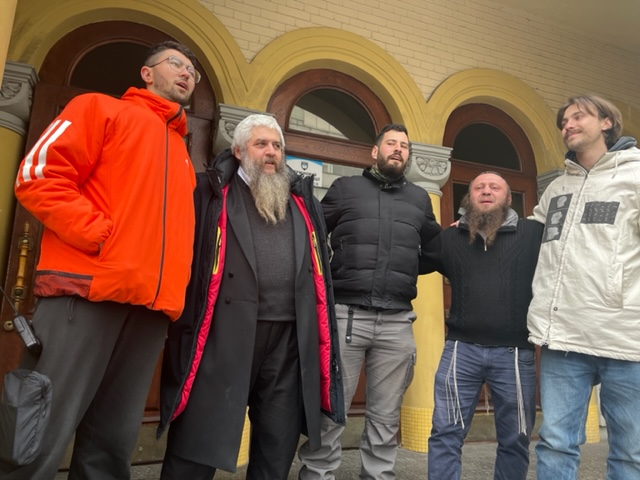
Kyiv, Ukraine — At the Brodsky Choral Synagogue in the heart of Kyiv, men cheerfully belt out Hebrew songs in the cold, cheered on by a small crowd.
In the midst of a war-torn landscape, this is a rare moment of light. Houses of worship are almost all shuttered for ordinary services; instead they've been transformed into evacuation meeting points and shelters for the displaced and desperate.
"I never thought this could happen here," says Moshe Azman, chief rabbi of Ukraine. "I feel like I am in a dream."
For those who remain in Kyiv, life has been reduced to the almost constant sound of artillery booming in the distance, the whirl of air-raid sirens compelling citizens to rush to the nearest bunker or parking lot below the earth. Indeed, the tension is palpable as Russian tanks inch closer. Almost everyone you know has lost someone, is missing someone, or cannot reach a loved one trapped in a Ukrainian town completely cut off from electricity, communication, food, medical supplies, running water, and heat amid the frozen temperatures.
Yet there is a profound pragmatism to Ukrainians, who have embraced their reality with determination, holding on to the serene lives they lived just over two weeks ago, while simultaneously letting the past go.
"In less than a week, I adapted to war. I changed my clothes and became a driver for the volunteers," notes Oleksandr Klymenko, snaking through the empty Kyiv streets at sundown. "Our lives changed so quickly; I changed so quickly."
The once vibrant capital city of 2.8 million has been entirely transformed into a frontline military zone. Streets are dotted with sandbagged checkpoints; vehicles must zigzag between concrete chunks and around World War II–style "steel hedgehogs" designed to puncture or belly-up encroaching enemies. Civilians tape large X's to the window and leave them just a crack open despite the frigid temperatures, believing it will limit the splattering of glass shards should a blast strike.
Kyiv is consumed by war. Everyone plays a part somehow. There are the soldiers, the volunteer soldiers, the women who cook the meals for the soldiers, and the medics who leave their own families to live in cold basements — on call 24/7 and ready to run to the wounded at a moment's notice. Famous chefs with shuttered restaurants now bake bread and concoct borscht for the fighters out in the bitter cold. Travel agents have transformed into communication vessels to find information about escape routes, convoys, and casualties.
Bright yellow school buses that once shuttled students across town on the edges of the city are now stuffed with exhausted, traumatized faces of evacuees pulled from broken towns after days of endless bombardment. There are buses whizzing down allegedly “green corridors” to “transition points,” where agonized faces are left with their suitcases, trying to wrap their heads around where to go next with no safe haven.
I see a teen boy, so young his gaunt face is still mottled by adolescent acne, standing by himself in the mud in an open field as evacuation buses from the outskirts of the city arrive. For hours, he watches each one intently, holding up a sign with his mother's name — the kind of sign you see a driver holding at the airport baggage claim — waiting for that familiar face. The sky darkens, and the bombing grows louder, closer, and still he stays waiting. The boy does not know if his family has survived the wild thrashing of the Russians.
Nearby, the very young, disabled, elderly, and confused cross the blown-up Irpin bridge — reeling with pain and unable to fathom the nightmare that has become their broken, homeless lives. Some are so old, so pained that they are bent double and barely able to walk, oblivious to the haunting artillery booms that seem to be growing closer and closer.
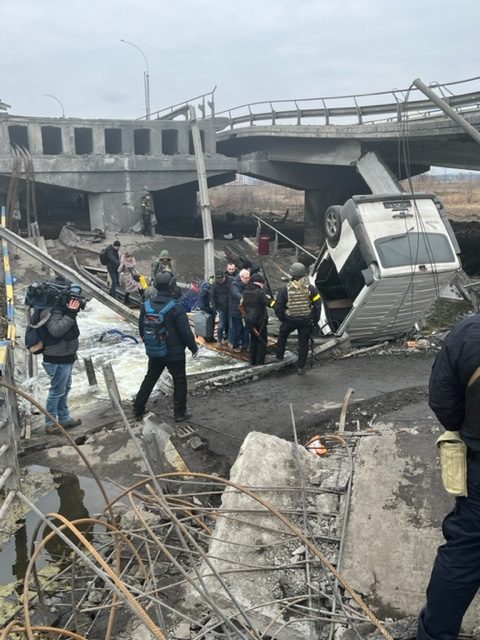
"We're poor and powerless," one woman, Ana, 23, tells me as she loads her babushka (grandmother) onto a stretcher of a local rescue ambulance. "Why?"
She sounded strong, but she was no doubt psychologically wounded, pacing up and down outside a parking lot littered with shell casings and debris.
Children who have already endured years of lockdowns amid the Covid-19 pandemic are out of school again, with no concept of when they may return to a classroom. Occasionally, I see small boys and girls wrapped in winter woolens playing in the snow as if caught in a serene bubble — until sirens again crack the air and parents whisk them away.
Each day, notifications pop up alerting citizens as to which markets and pharmacies across the city will be opened and for what hours. People cluster on upswept and snowy street corners, waiting to enter in small groups for essentials. Shelves are mostly wiped clean, with few imports making it into the capital as the war drags into its third week.
In search of shampoo, I scour the city center for every open market. After hours of searching, I finally uncover a dust-lathered bottle of laundry detergent, clutching it with excitement, as if it were trimmed in gold.
The luxuries of Uber or even the crammed subway system belong to a time before the war. One local taxi application called Uklon still functions, although the cars are limited. Instead, I see women all alone most mornings, dragging sleighs of supplies up the steep cobblestone hills to get them through the next days or weeks.
"Look!" says my friend Kirill, who was supposed to be graduating from film school this month but instead is toting a rifle in camouflage clothing, having just joined the civilian "Territorial Defenses" military wing. "Did you see that man carrying eggs? I can't believe it. I wonder where he found eggs."
It's the small salvages of the past that Ukrainians often long for the most: a steaming espresso from a trendy café, posting a letter, being able to buy an extra sweater as the temperature tumbles, a stiff drink to dull the anxiety.
Given the imposition of martial law the day the full-scale war flared, the sale of alcohol was immediately prohibited, and it remains locked in cases inside fast-emptying stores. One Ukrainian friend explains that this is because scores of men have voluntarily taken up arms to fight for the freedom of their land. The remaining Ukrainian males aged 18–60 are banned from leaving the country and must be willing to serve if needed.
"We can't have big groups of men with guns and ready for the fight if alcohol is still widely available," the friend says.
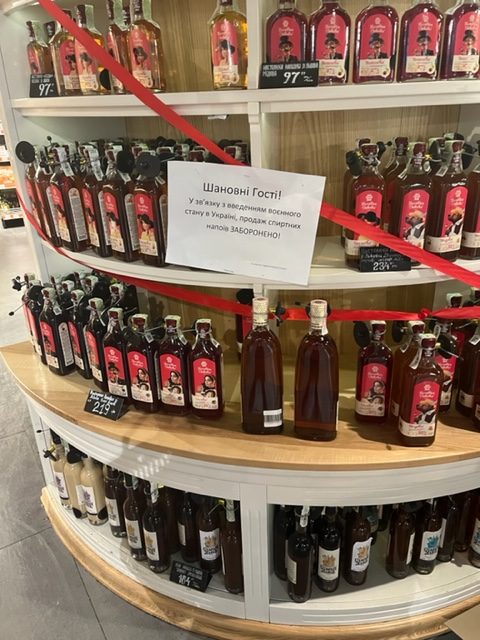
Another insists that they must no longer call "vodka" by that Russian name, mandating that Ukrainians now use "horilka" in the motherland's tongue.
Beyond a handful of depleted grocery stores, pharmacies, gas stations, and a few hotels to house foreign journalists and aid workers, nothing else is open. Early in the morning and late at night, I see wearied volunteer fighters with rifles strapped around their chests come to the hotel restaurant for a much-needed warm meal. When I venture downstairs in the darkness, I see them sleeping on thick chairs in the hotel lobby.
The ATMs are without cash, although most places in the city continue to accept card payments. Curfew comes into play between 8 p.m. and 7 a.m., meaning any unauthorized vehicle runs the risk of being shot at by Ukrainian guards. As with the night sky, houses are also blacked out with lights lowered to dim levels and curtains firmly drawn to avoid alerting potential enemies.
I meet a lovely young IT professional named Jen. Although a paraplegic, confined to a wheelchair and unable to use her arms, Jen uses a long straw between her lips to operate an iPad and uses her skills to report Russian hacks and disinformation channels.
The professional workforce of Kyiv has ground to a halt. Most civilians I talk to say their companies still pay their salaries, but men say they must take up arms with the Territorial Defense Force to keep their paycheck.
On another grey afternoon, I met a group of widows, grandmas, and old women hovering around the courtyard of their apartment building in central Kyiv preparing bottles and bottles of Molotov cocktails.
"My best weapon is my hands," Larissa, 60, says, her voice trembling but energized. "I will hit a Russian soldier with everything I have. I am not going anywhere."
They learned to make the notorious Molotov on the Internet. They cannot believe that their lives are centered on making amateur firebombs.
In the midst of the madness and chaos, there is also a collective drive for some semblance of order to control the things that are still in their control.
"It's important to park the car right," another friend Igor boasts, checking his distance to the curb on a vast and barren Kyiv Street. "Even in war, when there are no police, these little things matter."
Nevertheless, lives are halted in time. People cannot make plans or begin to think about what the future holds.
"I was supposed to graduate from film school next month," a Finnish-Ukrainian named Lukas says with a shrug. "I don't think it will ever happen."
However, he is not bitter and does not complain. It makes no sense to complain. Instead, Lukas documents what he can with a handheld video camera. He weighs whether he can better serve his people by telling the world about the atrocities or by joining the armed forces.
Lives are halted but they are also frequently interrupted. The air-raid warnings ring out at all hours of the night and day, and the people of Kyiv have amended once cold and dusty bunkers into mini makeshift homes with stored water and canned food and thin mattresses to sleep on. No one knows how long you might need to spend there — maybe ten minutes, maybe ten hours.
To cross from the east side to the west side of the city is an expedition taking more than four hours each way, as checkpoints and road closures and document checks snag the way. But, again, it makes no sense to grow irritated. Billboards along the journey used to advertise fancy hotels and spa-service getaways. Now, they come with war-centric signs such as "NATO, close the skies" and warnings to the Russian invaders that they will be "greeted with bullets, not flowers."
One moment, the local you are talking to appears calm and collected. The next comes an outburst of anger and then tears. People cannot believe that their homeland is being plunged into conventional 20th-century war in the 21st century.
The Ukrainian soldiers do not want glory or medals or money or fame. They want their freedom; they want their lives as they were a couple of weeks ago, although they know deep down nothing will ever be the same again.
"I took my wife and children to the Polish border and then came back to fight," one volunteer, Oleski, 29, tells me from a quiet street near the presidential buildings that were once a vibrant attraction, boasting Ukraine's most treasured and historical sites. "It is easier for us to fight harder when we know our families are safe, that someone else is taking care of them."
Almost everyone is defiant in assuring me that Ukraine will win this war. Nobody wants to imagine what would happen if they do not.
"We will never give in, never," adds Gennadiy Druzenko, a lawyer-turned-medic and co-founder of the Pirogov First Volunteer Mobile Hospital. "This war will become a guerrilla war and will go on for a very long time."
 |
| | |||||||||||||||||||||||||


 |  |  |  |  |  |  |  |  |  |  |  |  |  |  |  |  |  |  |  |





No comments: